Diamond is Unbreakable ― The Work of Crystallising Decisional Knowledge in the Age of AI
We hear constantly about a future where AI fully automates business1. Picture a digital control centre pulling all your data into one place, with an AI reading the situation and running the campaigns. But no matter how smart AI gets, one job will remain with humans until the very end: crystallising an organisation’s criteria for judgment—the “in this case, do this” rules—and sharing them. Crunching data is the AI’s job. Carving out and continuously polishing those crystals of judgment will be ours.
I normally work as a marketer. Break the job down, and it roughly involves four steps: observing the market and customers; forming a hypothesis, planning, and executing; looking at the results to discuss them; and deciding the next move. Pair the first three with AI, and they move overwhelmingly faster. The problem is the final part: deciding “which move to take.”
At least for now, I still can’t hand this off to AI. In fact, it might just remain in human hands until the very end.
What AI Cannot Do
Embodiment and Responsibility
The territory from data collection to analysis is “mostly solved.” What remains is the final destination: how to holistically interpret the gathered data, what to call a “success,” and by what criteria to decide the next move. This is where AI hits a wall. Judgment inevitably requires embodiment and responsibility.
Much of the world’s information hasn’t been turned into data. The feel at your fingertips, the tension in the air, the micro-reactions on another person’s face. You cannot properly assess a situation without the tacit, embodied knowledge that lives only in our sensory organs and neural pathways.
Then there is the problem of responsibility. You cannot put an AI in prison. When an AI’s judgment harms someone, the people held to account are the executives who designed it, the managers who operate it, or the person on the ground who pushed the button. At the final point of decision-making, a flesh-and-blood human must sign the paper. Therefore, an AI cannot act until a human answers the question: “What criteria should we use to judge this time?”
Even the people building the AI acknowledge this2. Microsoft’s Satya Nadella positions AI as an amplifier supporting human judgment. Meanwhile, Anthropic’s Dario Amodei has stated that frontier AI systems lack the reliability for fully autonomous decision-making, making human involvement indispensable.
The Root Problem in Business System Rollouts
The technology isn’t lacking. The problem is that the human side doesn’t have the criteria for judgment. We see this exact pattern every time an organisation introduces a new technology.
Roll out business systems like CRM, SFA, or MA, and you usually hit the same wall. Generative AI will likely be no different. A consultant might draw up a beautiful roadmap or flowchart, but if the organisation hasn’t accumulated the experience of “in this case, do this,” the system becomes a white elephant within six months. SFA degrades into an expensive Excel for deal tracking, MA into an expensive email blaster, and CRM — once an ideal — into a mere customer roster. The human side’s criteria must come first—things like the threshold for escalation or the conditions for re-engaging dormant leads.
As a slight digression, drawing those criteria out from clients through dialogue, articulating them, and dropping them into the system is exactly the value a consultant brings. Precisely because they are a third party, they can distance themselves from the organisation’s biases and look at the contours of judgment objectively. I can say this with conviction from my own lived experience on the front lines as a system implementation and marketing consultant.
So, what exactly is this “judgment” that we cannot fully entrust to AI? Let’s return to the root.
The Criteria for “Judgment” and “Decision-Making”
It’s not that AI can’t make judgments. Give it conditions like “Is this inquiry urgent?” or “Is the tone of this article appropriate?”, and it handles the branching quickly.
But that is merely following definitions supplied by humans in advance. True decision-making sits one step earlier. Building the framework of “in this case, do this” is human work.
Where does that framework come from?
What Learning Is
Through the lens of biology, it comes down to adapting to the environment. In a primitive settlement, when the weather turns harsh, who does what? When a dispute arises with a neighbouring settlement, what do we do? If everyone acts on their own, the group collapses. Moving in sync as a group in response to unfolding events is the essence of human “learning.”
It is exactly the same in a modern organisation. When the market moves, which budget do we keep? When a competitor makes a move, how do we respond? When a team member leaves, who covers for them? The problems change, but the act of aligning how the group behaves remains continuous from primitive times.
An organisation’s judgment is the act of sharing the learning of “in this case, it is better to do this” as rules and lessons. It means deciding in advance how the group will respond to events.
Seen this way, the reason AI-driven automation stalls comes into focus. The rules weren’t set. The organisation hadn’t aligned on how to move.
Knowledge and Experience Diverge
The tricky part is that the rule of “in this case, do this” can only be made once you’ve experienced that case. An organisation that has never faced a drastic market shift cannot write down a perfect countermeasure from the start. You don’t know until you try, and when you do try, the unexpected happens.
You don’t necessarily have to experience it directly yourself, though. By reading someone else’s recorded judgment or story, the brain processes it as a simulated experience—just as hearing about a burn makes you wary of fire. In organisational learning, this is known as vicarious learning3. We read books, ask our predecessors, and trace the case studies of other organisations.
Still, borrowed knowledge is never perfect. The map is not the territory4. The preconditions of someone else’s judgment are always slightly different from your own. Someone who learns that “water puts out fire” will cause a disaster if they pour water on an oil fire. Borrowed criteria must be applied tentatively and re-polished to fit the actual substance of your own organisation.
Judgment, then, is the act of narrowing down a solution space within constraints and making a choice. At least, that’s how it looks to me. Environmental, market, organisational, and interpersonal constraints all dictate the degrees of freedom in your solution space. Within those bounds, you discern the optimal answer for that specific moment. In the formal logic of computer science, this is known as a constraint satisfaction problem. It aligns perfectly with the etymology of intelligence: “to choose from between.”
So where do those rules live inside the organisation?
Information, Knowledge, Intelligence, and Wisdom
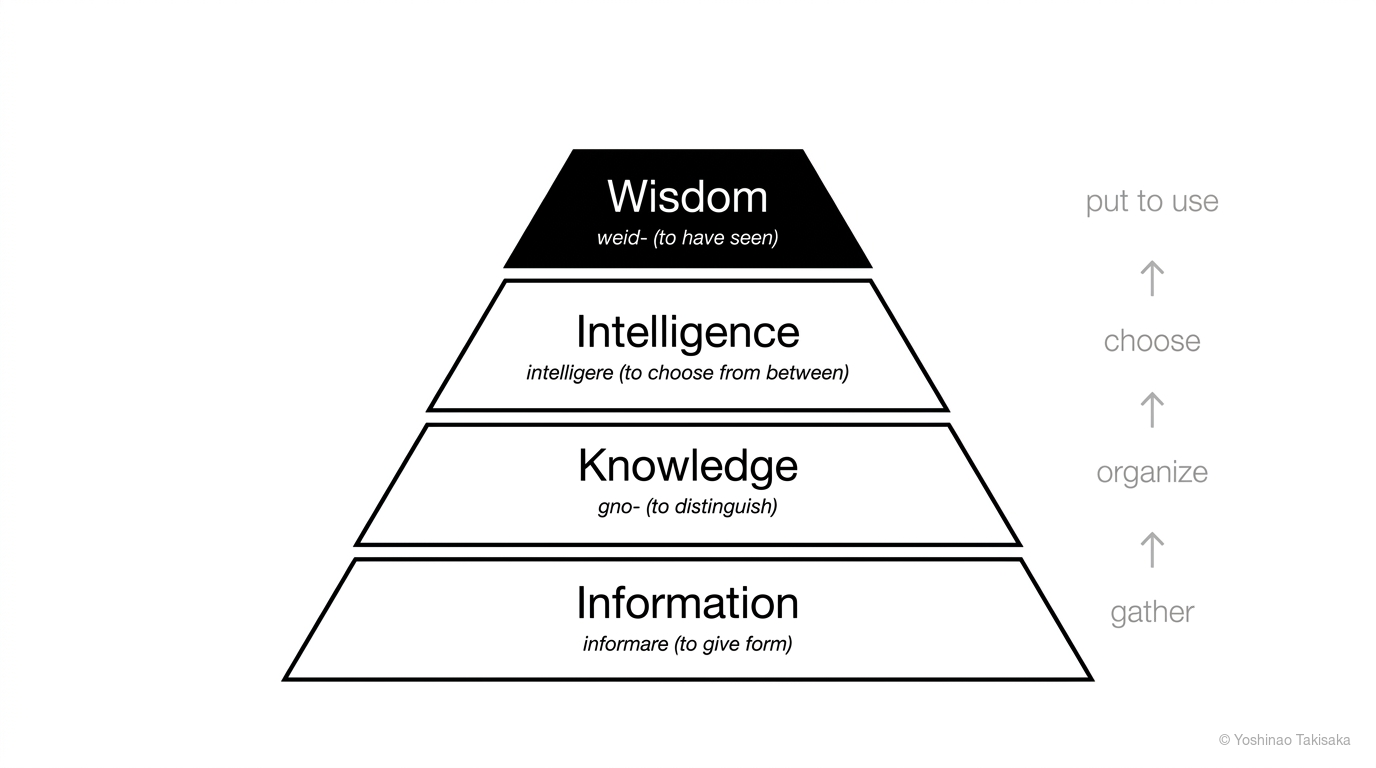
What does “organisational knowledge” actually refer to? Information, knowledge, intelligence, and wisdom. I want to lightly untangle the differences between these four words through their etymologies.
Information
Information is raw material—sales data or meeting transcripts. It has no direction of its own. The word information comes from the Latin informare, “to give form.” It implies material that only begins to hold meaning in a person’s head once it takes a specific shape.
Knowledge
Knowledge is arranged information. It is a referenceable combination of facts, such as “the purchase rate increased by 15%.” The root of the word knowledge traces back to the Proto-Indo-European gno-, “to discern.” Arranging things so they can be distinguished is the core of knowledge.
Up to this point, we are in the undisputed domain of AI, which collects, arranges, and identifies effortlessly.
Intelligence
The etymology of intelligence is the Latin intelligere, from inter (between) + legere (to pick or read). Translated literally, it means “to pick from between.” Historically, intelligence has always carried this movement of picking the appropriate option from multiple possibilities.
AI also performs this movement, returning one answer from multiple candidates. Artificial intelligence—“the capacity to pick from between, artificially”—is, etymologically, a remarkably apt name. Yet the criteria for what counts as “appropriate” are supplied by us. The criteria for choosing remain firmly on the human side.
Wisdom
The word wisdom comes from the Proto-Indo-European weid- (to see), essentially meaning “the state of having seen.” It is the judgment acquired by someone who has actually navigated a situation. Knowing how to move when the grass rustles, or what to do when you hear a storm approaching. It is a form of judgment born not from books, but from lived, embodied experience.
Collecting knowledge does not turn it into wisdom. Wisdom is the shape of how knowledge gets used.
Where Does Wisdom Live Inside the Organisation?
This shape of use is scattered everywhere in an organisation.
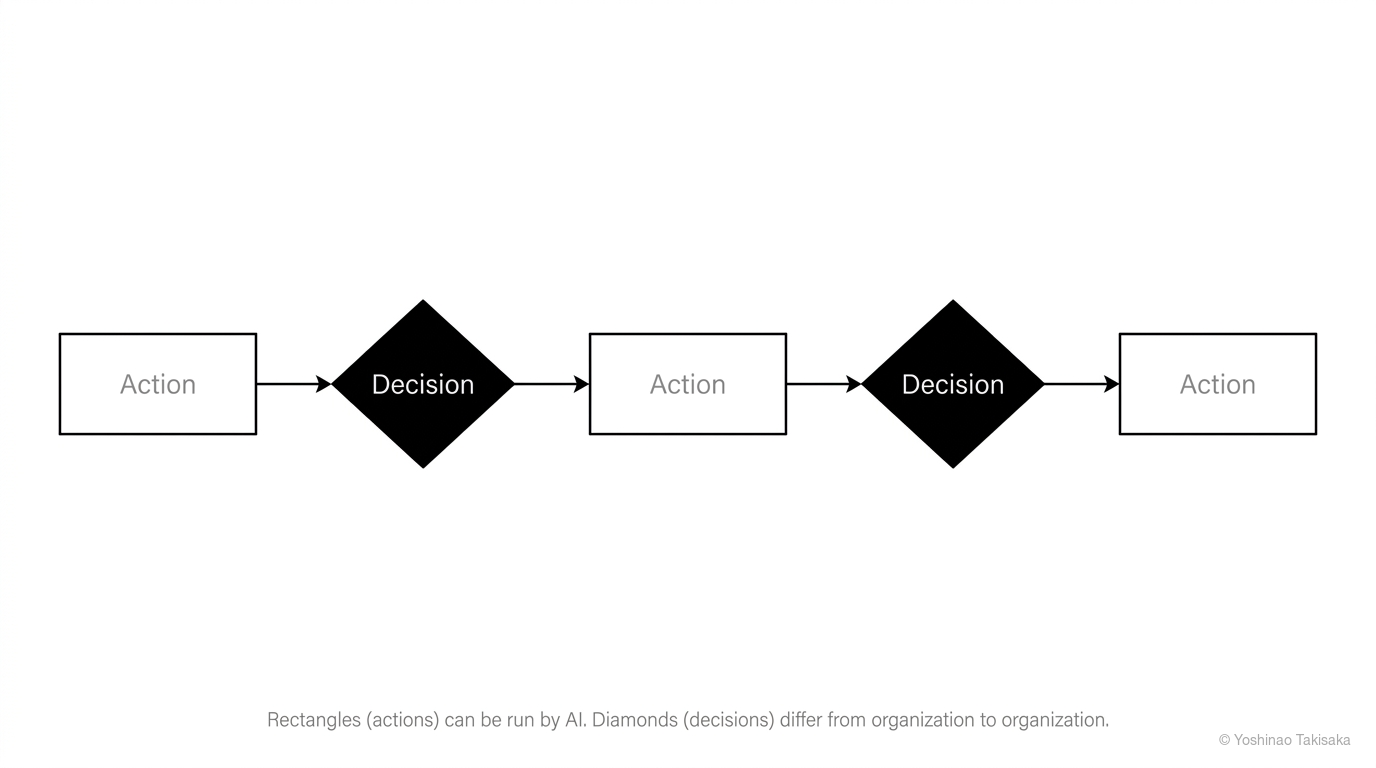
Whether in sales or marketing, the patterns of action are mostly fixed. The difference emerges in the judgments made in between. Whether to submit a quote or pass. Whether to allocate budget to a specific campaign. In flowchart terms, the difference doesn’t appear in the rectangles (actions), but in the diamonds (judgments). The conditions deciding the Yes/No branch differ from one organisation to the next.
It’s not just on the front lines. When the executive team aligns on targets, or when a manager plans the team’s workload, the core task is the same. Regardless of the layer, they are deciding what to do, under what conditions, in a given situation.
However, these diamonds tend to get buried.
They live in the head of a seasoned sales rep, or an engineer who has been there since the founding. These shapes of judgment are dispersed across individual bodies. If that person resigns, the diamond vanishes into thin air. As long as it remains locked inside an individual, it cannot be shared with AI or with new members.
Wisdom Is the Organisation’s Knowledge
An organisation’s knowledge is neither its volume of knowledge nor its volume of information. It is wisdom—the diamond of crystallised value and judgment criteria: “in this case, do this.”
For an organisation to “know” something means collectively holding and aligning the correct diamonds for each situation.
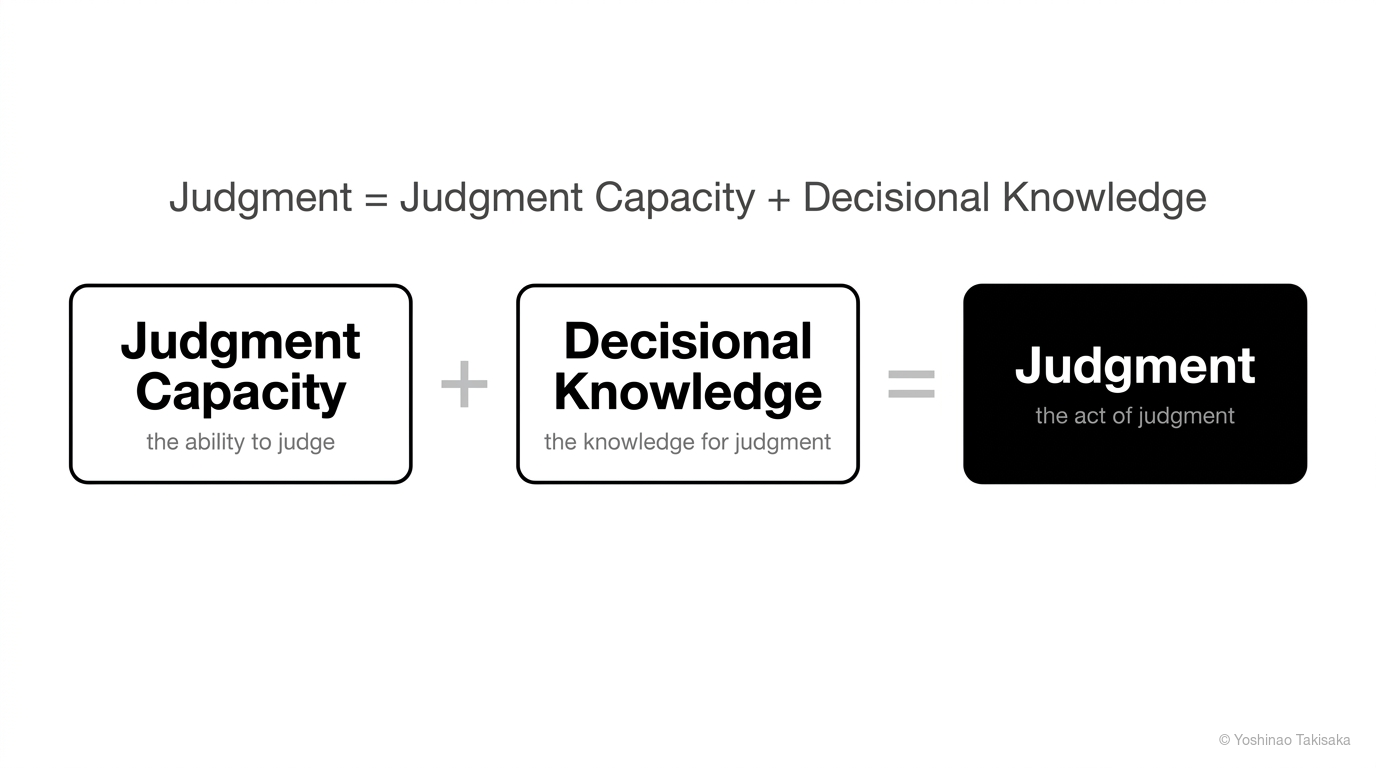
In this essay, I will call this crystallised diamond decisional knowledge (or judgment knowledge). It is the knowledge required for judgment. Using information and knowledge as raw materials, it is the crystallised criteria by which an organisation decides “in this case, do this.” It points not to the capacity for judgment, but to the accumulation of knowledge required for judgment. It is a concept closely related to phronesis (practical wisdom) and tacit knowledge.
Crystallise Decisional Knowledge
So what does crystallised decisional knowledge look like in practice?
It takes the form of organisational guidelines, business rules, regulations, templates, decision logic built into business systems, and automation engines. The formats vary, but they all take “in this case, do this” out of the human body and turn it into a shared organisational asset. Crystallisation progresses through three distinct layers: articulation → systematisation → technologisation.
Working backward from that, we only need to do three things to crystallise decisional knowledge. It comes down to a stack of quiet work.
- Write it down: Leave a record of why a judgment was made. Why was this budget set? Why was this person hired? Write out the conditions and the discarded options, whether in Slack or meeting minutes.
- Calibrate against others: Bring those written criteria up against other people’s views. Draw out the reasoning in a 1-on-1, or gather non-negotiables at the start of a project. Turn the diamond inside one person’s head into a shape that multiple people can touch.
- Keep updating: Even written criteria fall out of step as the market changes. The less frequently they are touched, the faster they ossify. Tend to them periodically, and re-polish them to fit the current reality.
Information rots. Therefore, we re-polish it.
Writing it down, calibrating it, updating it. The accumulation of that work remains as a crystal—embedded in guidelines, rules, and logic.
We must be careful of survivorship bias here. Success stories are easy to keep, but failures hold far more information density as criteria for judgment. Under what conditions did things collapse, and why? That is where you find the hints to avoid making the same mistake twice.
In the era ahead, humans must hold onto the meta-judgment: which diamonds do we hand to the AI, and which do we polish ourselves?
The framework of decisional knowledge proposed in this essay is itself a tool for dialogue on the ground. “What kind of decisional knowledge is our organisation lacking?” “What should we decide next?” “What form should we drop it into?” Discussing these questions with the team and ironing them out—deciding what to agree on together—becomes the entry point to crystallisation.
The “Decisional Knowledge Matrix” for Crystallising Organisational Knowledge
The diamonds inside an organisation are not all in the same state. How you handle them depends on where they sit.
Let’s call this the Decisional Knowledge Matrix. It is divided into four quadrants along two axes: accumulation of experience (repeated experience vs. no prior experience) and degree of articulation (tacit vs. articulated)5.
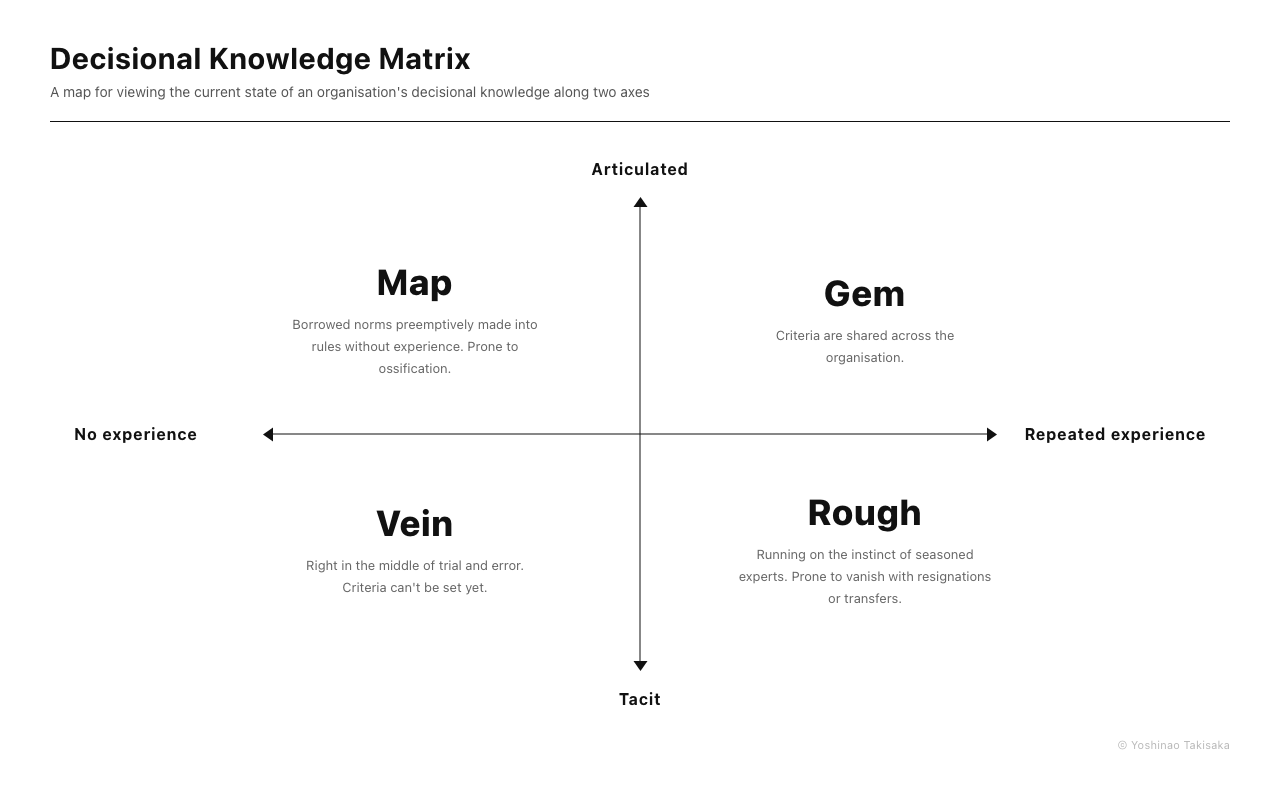
- Map Zone (no prior experience × articulated): Borrowed norms preemptively made into rules without firsthand experience. Many areas here are prone to ossification.
- Vein Zone (no prior experience × tacit): Right in the middle of trial and error.
- Rough Zone (repeated experience × tacit): Running on the instinct of seasoned experts. Prone to vanishing when people resign.
- Gem Zone (repeated experience × articulated): The state where criteria are shared across the organisation.
There is no ideal distribution, but the thickness of the Gem Zone supports the stability of the organisation’s knowledge. Four pathways run between these quadrants:
- Map → Gem: Internalising the borrowed. The map is not the territory4—operate the borrowed criteria tentatively on the ground, and re-polish them to fit the actual substance of your organisation. This is the work of walking the map to verify it.
- Map → Discard: Discard the maps that don’t fit. Don’t stack up facades.
- Vein → Rough: Mining. Keep running trial and error, letting experience accumulate inside the organisation.
- Rough → Gem: Polishing. Draw out the seasoned expert’s instinct through 1-on-1s and templates, putting it into words.
That said, the carved gem cannot scoop up everything in the rough. Some experience is always shaved off in the polishing, and not every experience can be put into words or formalised—a premise cognitive science and learning theory have consistently held. Crystallisation is pursued with the awareness that these losses are inevitable.
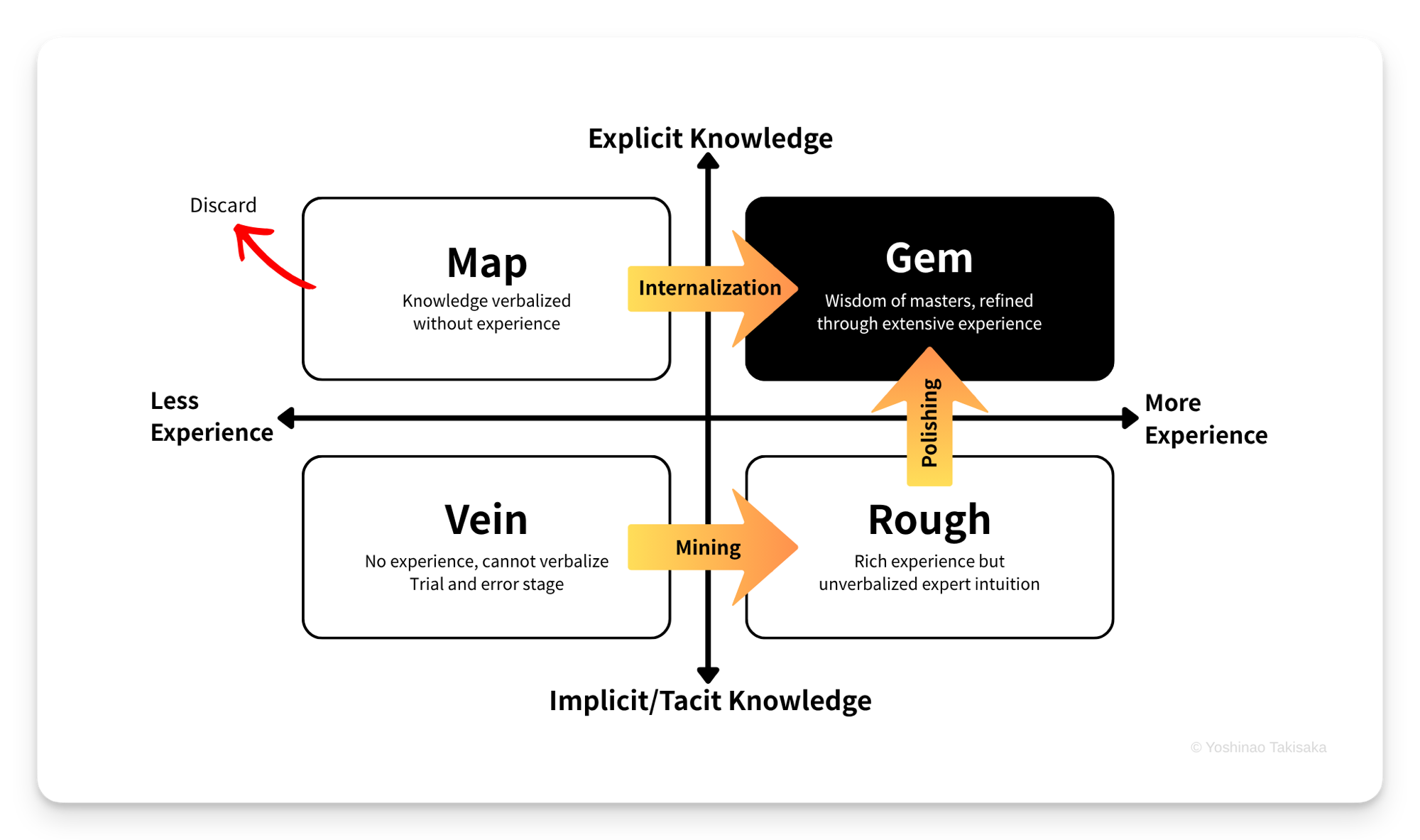
The quadrants are not fixed. The same judgment moves with time and experience: from no prior experience to repeated experience, from a tacit state to an articulated one, traversing the four quadrants. It is worth mapping out where your own team’s or organisation’s criteria currently lean.
This matrix is also a tool for mining your organisation’s diamonds. I’ll leave some questions here to help unearth the diamonds sleeping in each quadrant:
- Map Zone: Are there preemptive rules that simply aren’t functioning on the ground?
- Vein Zone: Which judgments are still in trial and error, with no settled criteria?
- Rough Zone: Which judgments make people say, “We can’t run this without that person”?
- Gem Zone: Which judgments have aligned criteria and can be reproduced by anyone?
Try mining your organisation’s diamonds using this matrix. Identifying the “we can’t run this without that person” bottlenecks, the ongoing trial-and-error efforts, and the non-functioning rules makes it much easier to figure out where to start polishing.
This work of continuously polishing an organisation’s decisional knowledge doesn’t end with the immediate management of a team. It is part of a much longer story.
Values Are Crystallised Decisional Knowledge
Amid recent trends in purpose-driven management and human capital management, more companies are reviewing or rewriting their Mission, Vision, and Values (MVV). Values in particular—how to define behavioural guidelines and criteria for value judgments—tend to become the focal point of discussion.
This matrix can be used exactly as is for sorting out Values. Ultimately, Values and behavioural guidelines are the crystallised, verbalised form of the judgment criteria an organisation must hold to follow its purpose, realise its social mission, and bring the business closer to its ideal state. They are decisional knowledge and lessons translated into words of action.
Some are generated in-house, while others are borrowed from other companies. Both coexist.
Often, however, people simply borrow and line up words used by famous or large companies. They sound nice, but without the organisation’s own experience embedded in them, they are merely a facade. Because they are not decisional knowledge crystallised on the organisation’s own front lines, the Values become an empty shell. If you work in branding or HR consulting, you witness this issue every single day.
The root cause is the same as the SFA or CRM empty-box problem I mentioned earlier. Words borrowed without passing through experience do not become diamonds. Borrowed criteria must be applied tentatively and re-polished to fit the actual substance of the organisation. Values require that exact same two-step effort.
Actually, this essay itself is an example. The text you are reading right now was mostly written by AI at my direction. The granularity of expression, the rhythm of connections, the candidate vocabulary—AI offers these up overwhelmingly fast. But the foundational experiences are mine, and deciding what to write from them, what not to write, how deep to go, in what style to deliver the words, and where to call it finished—those criteria for judgment exist only with the writer. My values as a writer, the contours of how I want the reader to receive the text, the boundaries of the experiences I choose to keep hidden. None of these can be handed over to AI. If I had assembled this essay using only safe, borrowed words, it too would have been a facade. In the age of AI, what remains for the writer is not the hand that types the letters, but the judgment that decides what not to write.
Continuously polishing an organisation’s decisional knowledge doesn’t end with the immediate management of a team. It is part of a much longer story.
Diamond is Unbreakable
Humanity has survived by turning knowledge into tools. We externalised lessons—like how to start a fire—through oral tradition, books, and stories, passing them from hand to hand. The scriptures of world religions, folklore passed down across generations like Aesop’s fables, picture books for children. Each is a lesson humanity polished through vast accumulated experience, reshaped into a form the next generation can easily receive. “When this happens, it is better to do this,” carried on the bodily sensation of story and parable. The diamonds passed down across eras are humanity’s treasure.
The method for starting a fire was passed down orally for millennia, written in books, and finally burned into tools. Today, you press a single button and the rice cooks. Inside that rice cooker, the “in this case, do this” knowledge accumulated by past generations is embedded so deeply it can no longer be extracted. The washing machine is the same. The combination of fabric type, soil level, water temperature, and spin speed—judgments once remembered in the bodies of washerwomen—have been burned in as the logic of the machine. The safety controls of an elevator, the cycle of a traffic light, the automated translation engine. The act of detaching decisional knowledge from the human body and making it operable in another form. This is the ultimate destination of turning knowledge into tools.
Organisations are no different.
Collecting endless data or training an AI doesn’t guarantee an organisation will become smarter. To survive, you need a state where the diamonds of judgment are not locked inside specific bodies, but are carved out as tools within everyone’s reach, and continuously re-polished.
Diamond is unbreakable6. Even if someone leaves, or the AI upgrades to a new model, the crystallised judgment remains, becoming the support for the next generation.
If you spot a diamond somewhere in a flowchart, stop and think for a moment. Are those conditions in step with where you are now? Is there an unmined diamond sleeping in someone’s head? Extract it, polish it, and re-polish it. That is how, grain by grain, you turn an organisation’s knowledge into crystals of diamond.
Thank you for reading to the end.
Was there a moment in your work where you managed to articulate a “criterion for judgment”? Or, if there is a criterion of your own that you sense exists but haven’t yet been able to put into words, what would it be?
If something here resonated, a like (♡) would mean a great deal. A Restack or share, passing it on to someone else, would be even more encouraging.
Until the next post.
Notes
Background and Influences
A short index of the concepts, thinkers, and underground currents that informed this essay — entry points for those who’d like to trace them further.
Theoretical references (cited in the body):
- Albert Bandura, “vicarious learning” (Social Learning Theory, Prentice-Hall, 1977)
- Alfred Korzybski, “the map is not the territory” (Science and Sanity, 1933)
- Niklas Luhmann, “decision chains” and “autopoiesis” — describing organisations not as collections of individuals but as chains in which past decisions condition the next. This essay drew on the persistence side of that lens; the same concept is also used to analyse organisational path-dependency and institutional rigidity (Soziale Systeme, 1984; Organisation und Entscheidung, 2000)
- Ikujiro Nonaka & Hirotaka Takeuchi, “SECI model” (The Knowledge-Creating Company, Oxford University Press, 1995)
Concepts that supported the essay without being named in the body:
- Michael Polanyi, “tacit knowledge” — the distant root of the embodiment discussion
- James G. March, “exploration vs exploitation” — the balance argument behind not treating crystallisation as an absolute good
- Chris Argyris, “espoused theory vs theory-in-use” — the gap between written criteria and actual operation
- Pfeffer & Sutton, “the knowing-doing gap” — the gap between what one knows and what one can actually carry out
* This essay was developed by deepening my (Yoshinao Takisaka’s) own lived experience through AI-led interviews, and was composed and written in collaboration with AI. Powered by Gemini and Claude.
* Some illustrations and diagrams were generated by AI after the essay was written.
Footnotes
-
As one indicator of the discourse around AI-driven full automation, Gartner predicts that up to 40% of enterprise applications will feature task-specific AI agents by the end of 2026, up from less than 5% in 2025. Gartner, “Predicts 40% of Enterprise Apps Will Feature Task-Specific AI Agents by 2026” (August 2025). In marketing specifically, industry coverage has shifted to “AI that manages entire campaign lifecycles — selecting audiences, generating creative, allocating budgets, measuring outcomes”. CMSWire, “Digital Experience in 2026: Will Agentic AI Automation Shift the Marketing Tech Stack?” (2026). Command-centre style solutions are already shipping in adjacent domains: Dematic unveiled its “Command Center” analytics platform at MODEX 2026 — “Dematic to Debut New Command Center Analytics Platform at MODEX 2026”. At the same time, Gartner predicts that more than 40% of agentic AI projects will be cancelled by the end of 2027 — costs, unclear value, and inadequate risk controls. Gartner, “Predicts Over 40% of Agentic AI Projects Will Be Canceled by End of 2027” (June 2025). The hype and the abandonment are running in parallel. ↩
-
AI providers in their own words. Microsoft CEO Satya Nadella, in a late-2025 essay, positioned 2026 as the pivot from “model-level dazzle” to systems that act as a “cognitive amplifier” for human judgment. Satya Nadella, “Looking Ahead to 2026” (LinkedIn, December 2025). Anthropic CEO Dario Amodei has identified fully-autonomous decision-making as outside the current reliability envelope for frontier AI, treating human involvement at critical judgment points as a stated “red line”. CBS News, “AI executive Dario Amodei on the red lines Anthropic would not cross”. OpenAI CEO Sam Altman, in his essay “The Intelligence Age”, writes that AI empowers individuals while “humans need to make decisions about the future and new rules collectively”. Sam Altman, “The Intelligence Age”. ↩
-
“Vicarious learning” was systematised by the psychologist Albert Bandura in Social Learning Theory (Prentice-Hall, 1977), describing how learning takes place by observing the behaviour and outcomes of others. Within organisational learning research the concept has been extended to processes by which one organisation learns from another’s experience (Barbara Levitt and James G. March, “Organisational Learning”, Annual Review of Sociology, 1988; Linda Argote, Organisational Learning: Creating, Retaining and Transferring Knowledge, Springer, 2013). I use the term here in the broader sense of borrowing someone else’s experience without putting one’s own body on the line. ↩
-
“A map is not the territory” is the central thesis of Alfred Korzybski’s Science and Sanity: An Introduction to Non-Aristotelian Systems and General Semantics (Institute of General Semantics, 1933), the founding work of general semantics. The principle — that the symbol (map) belongs to a different order of existence from the reality (territory) it represents — has since been invoked across many fields concerned with abstraction. ↩ ↩2
-
This “tacit / articulated” axis echoes the distinction between tacit and explicit knowledge in the SECI model, proposed by Ikujiro Nonaka and Hirotaka Takeuchi in The Knowledge-Creating Company: How Japanese Companies Create the Dynamics of Innovation (Oxford University Press, 1995). The SECI model describes how tacit and explicit knowledge circulate within an organisation through four conversion steps — Socialisation, Externalisation, Combination, and Internalisation. The “keep crystallising” practice in this essay can be positioned as a focus on externalisation (tacit → explicit), one of the four steps in that cycle. ↩
-
Diamond is Unbreakable is borrowed from Hirohiko Araki’s JoJo’s Bizarre Adventure: Part 4 — Diamond is Unbreakable (Shueisha, serialised in Weekly Shōnen Jump 1992-1995, 18 volumes in Jump Comics). In the work, the unbreakability of diamond stands as a symbol of “unshakable spirit” and “a sense of justice that does not yield to evil” (the so-called “golden spirit”), set against the fragility of the human heart. Borrowed as the title here for its resonance with this essay’s theme: the crystallisation of an organisation’s decisional knowledge. ↩