The Blind Spot of the Double Diamond ― A Tentative Argument for the Double Iceberg Model
Laying the iceberg down inside the Double Diamond ―― where explicit and tacit intersect, eight fields surface
Designing What’s Underneath ― from the Double Diamond to the Double Iceberg Model
This essay is a thought experiment on the design process, born at the intersection of the Double Diamond and the Iceberg Model. Read it as a working note for bringing the core concern of “What’s Underneath” — that the 90% beneath the surface carries more weight than the 10% above it — into the design process.
My notebook contains a sketch of the familiar Double Diamond: Discover, Define, Develop, Deliver. It’s a shape that has become the common language of the design process.
The other day, I added something to it: a single horizontal line piercing the centre of the diamonds. Above the line, I wrote “Explicit”; below it, “Implicit & tacit”. Next to it, a scribbled note: “water line”.
The moment I drew that line, something changed.
A familiar landscape suddenly looked entirely different. I will tentatively call this new shape the Double Iceberg Model.
Polanyi’s tacit knowledge. Nonaka and Takeuchi’s SECI model. The iceberg of systems thinking. This essay is an attempt to overlay the cognitive axis of the iceberg onto the time axis of the Double Diamond.
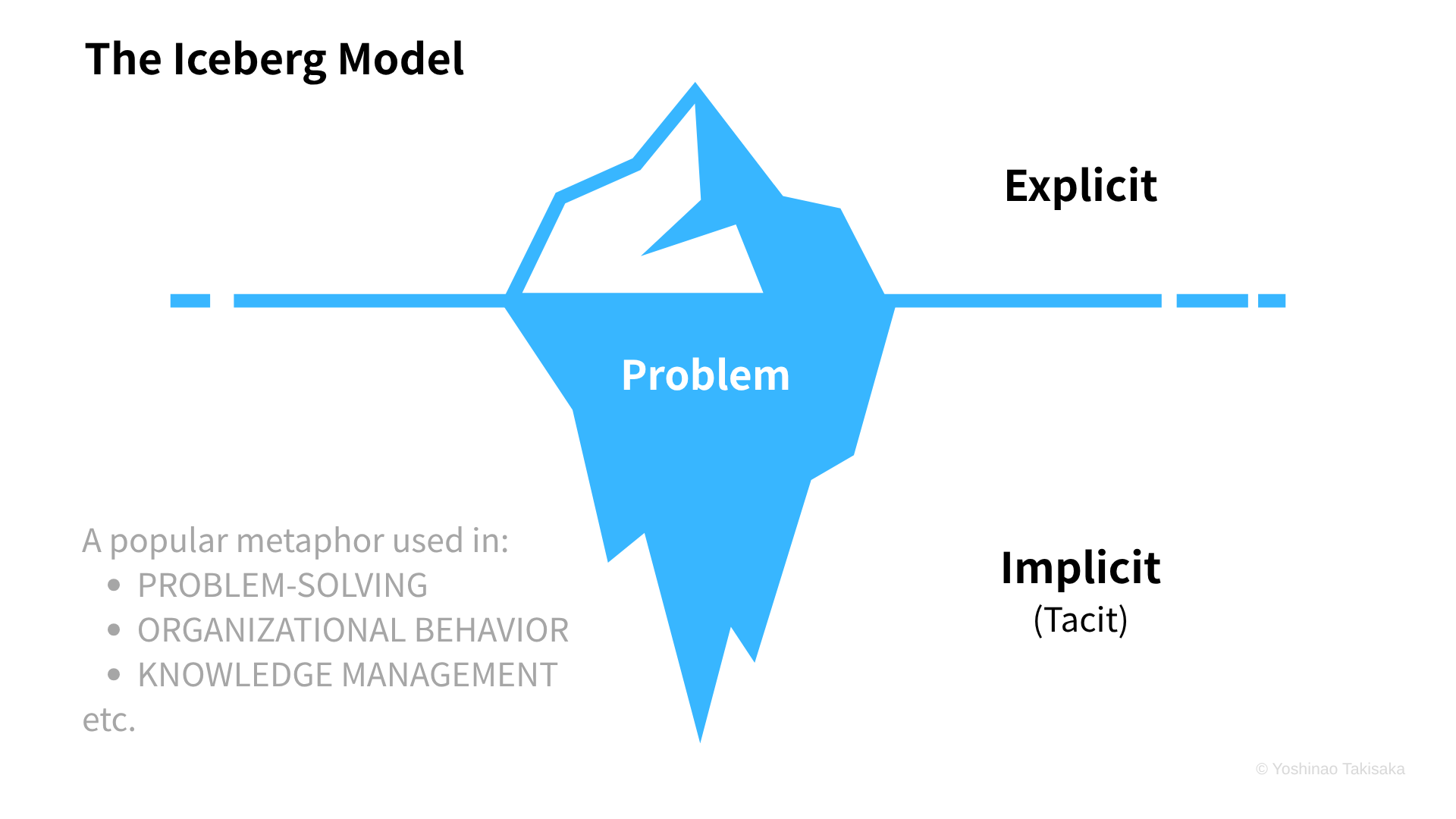 The Iceberg Model: a metaphor widely used in problem-solving, organisational behaviour, and knowledge management. What’s tacit (implicit / tacit) beneath the water supports what’s explicit above. This essay begins by laying this iceberg down across the time axis of the Double Diamond.
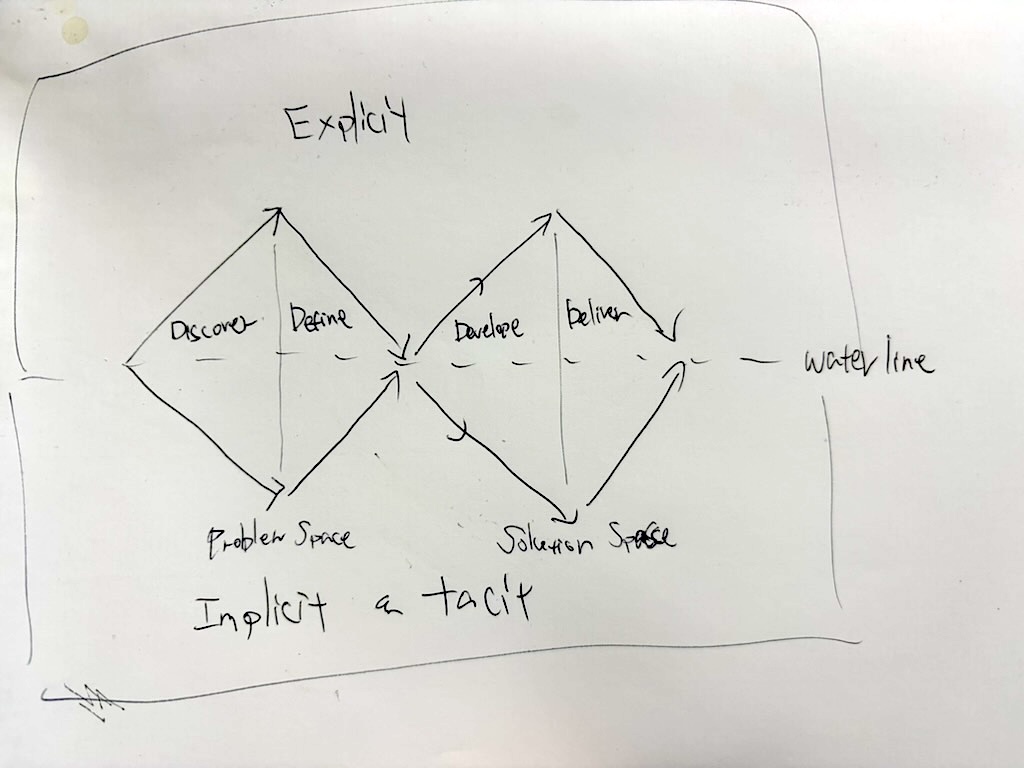 The author’s handwritten sketch (original): the moment I drew a “water line” through the centre of the Double Diamond in my notebook, adding “Explicit” above and “Implicit & tacit” below. The Problem Space and Solution Space extended both above and below the water surface. The stain in the top left is where I hastily spilt coffee when the idea struck me — oops.
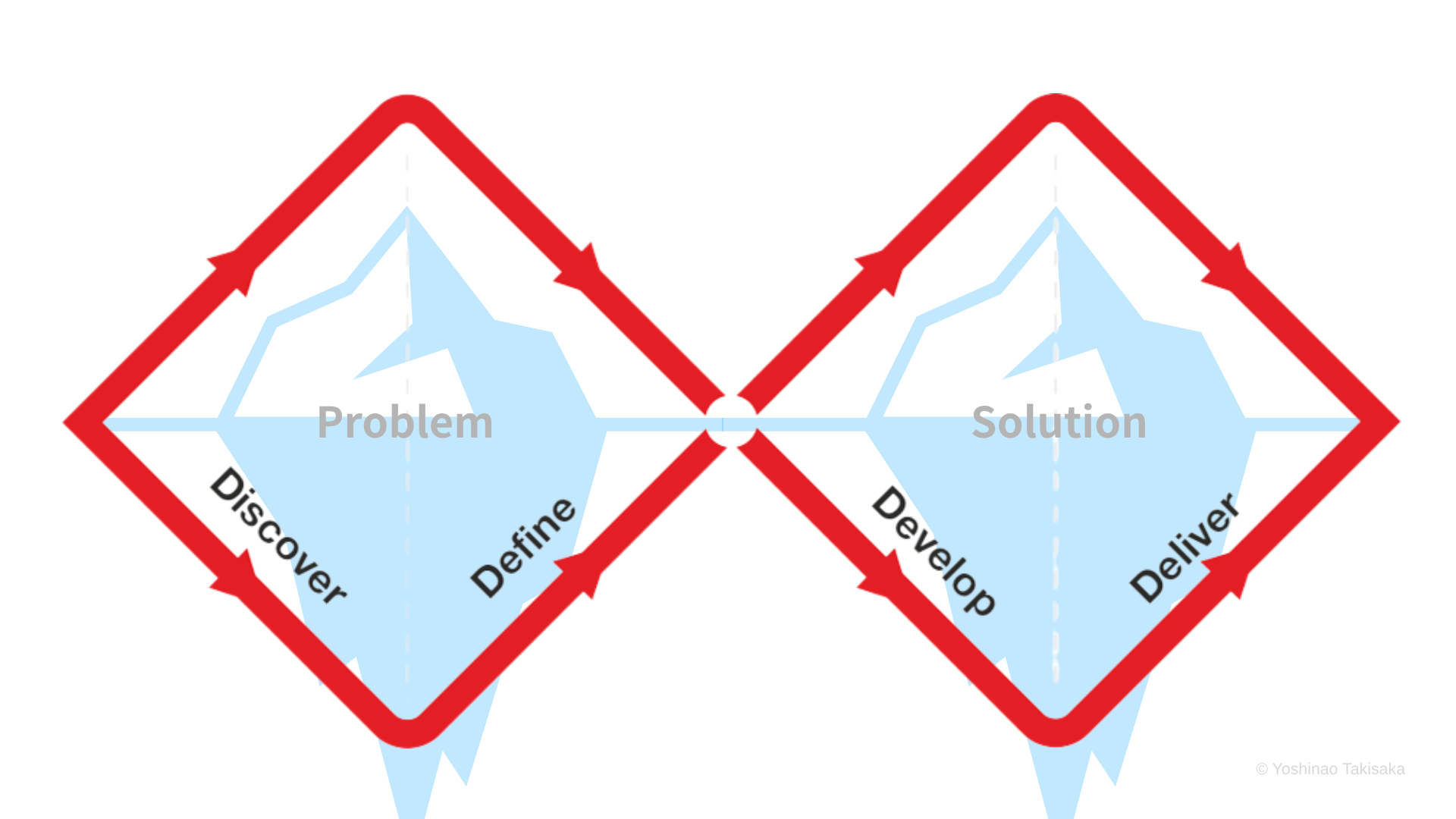 Laying the iceberg (the vertical axis of tacit and explicit) down inside the time axis of the Double Diamond: a thought experiment born at the intersection of two prior models.
What the Double Diamond Has Left Unsaid
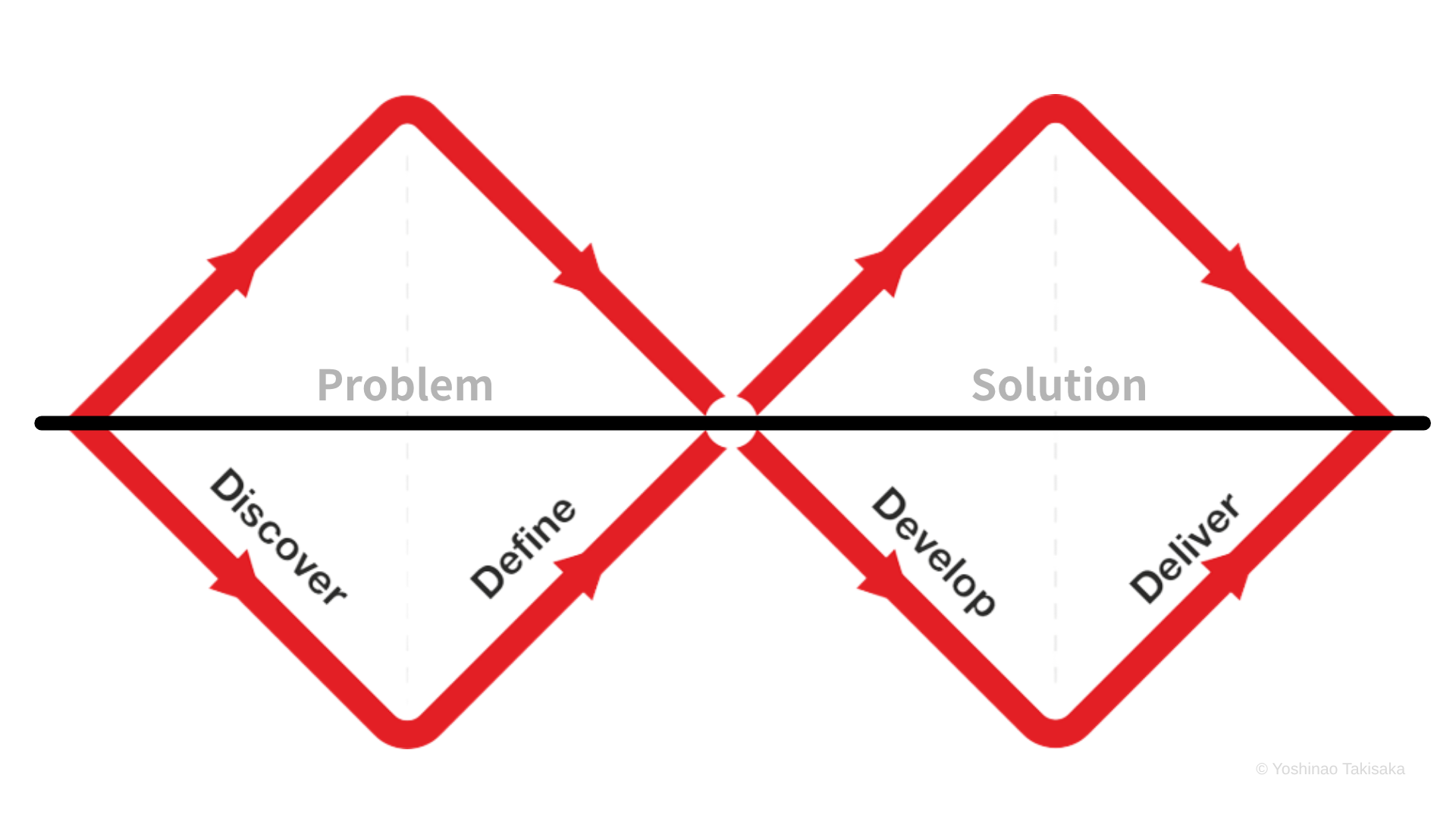
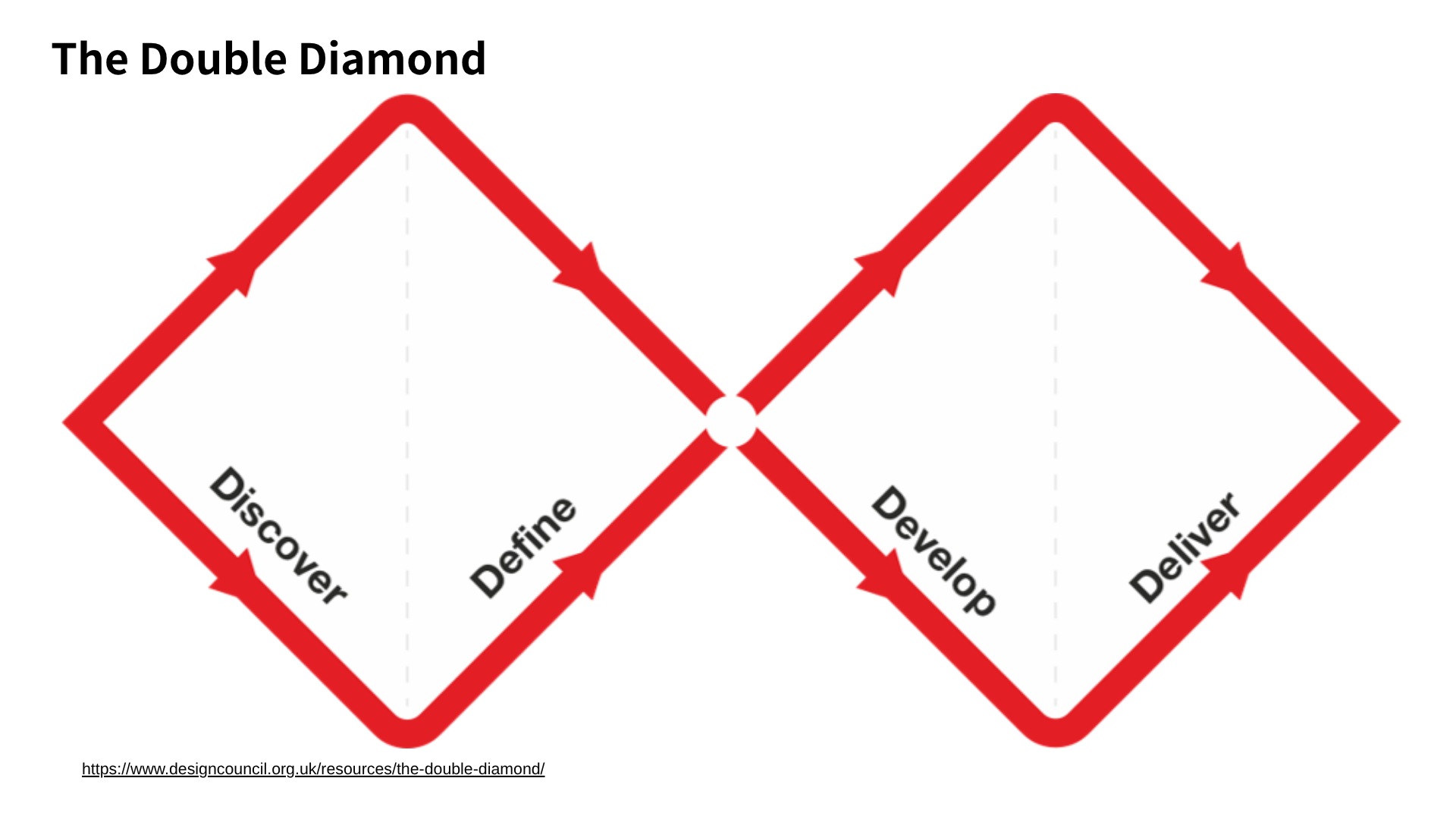 The Double Diamond: the common language of the design process, published by the UK Design Council (2005). It repeats divergence and convergence twice. Source: Design Council, “The Double Diamond”
The Double Diamond, published by the UK Design Council in 2005, is now common parlance in design education and practice worldwide. Building on the divergence-convergence model presented by Béla H. Bánáthy in 1996, it describes a project through four phases: Discover, Define, Develop, and Deliver. It is a powerful framework that visualises the rhythm of divergence and convergence, separating the problem space from the solution space.
Yet, after years of practice, I’ve come to feel this diagram misses something. It has four distinct limitations.
First, while it describes the ‘sequence’ along a time axis, it cannot capture the ‘quality’ of the process. It shows the transition between phases, but not how deeply a team has dived within them.
Second, it only depicts the width of divergence and convergence. We see lateral movement, but no depth.
Third, it leans heavily towards the explicit. Visualised deliverables — presentation slides, prototypes, specifications — easily become the sole objects of evaluation.
Fourth, it ignores the role of tacit knowledge. The embodied knowledge, intuition, and ability to read a room that excellent designers rely on simply aren’t part of the model’s vocabulary.
It tells us “when to do what”. But the model has left unsaid “at what depth, and how far the reach of inquiry should extend”.
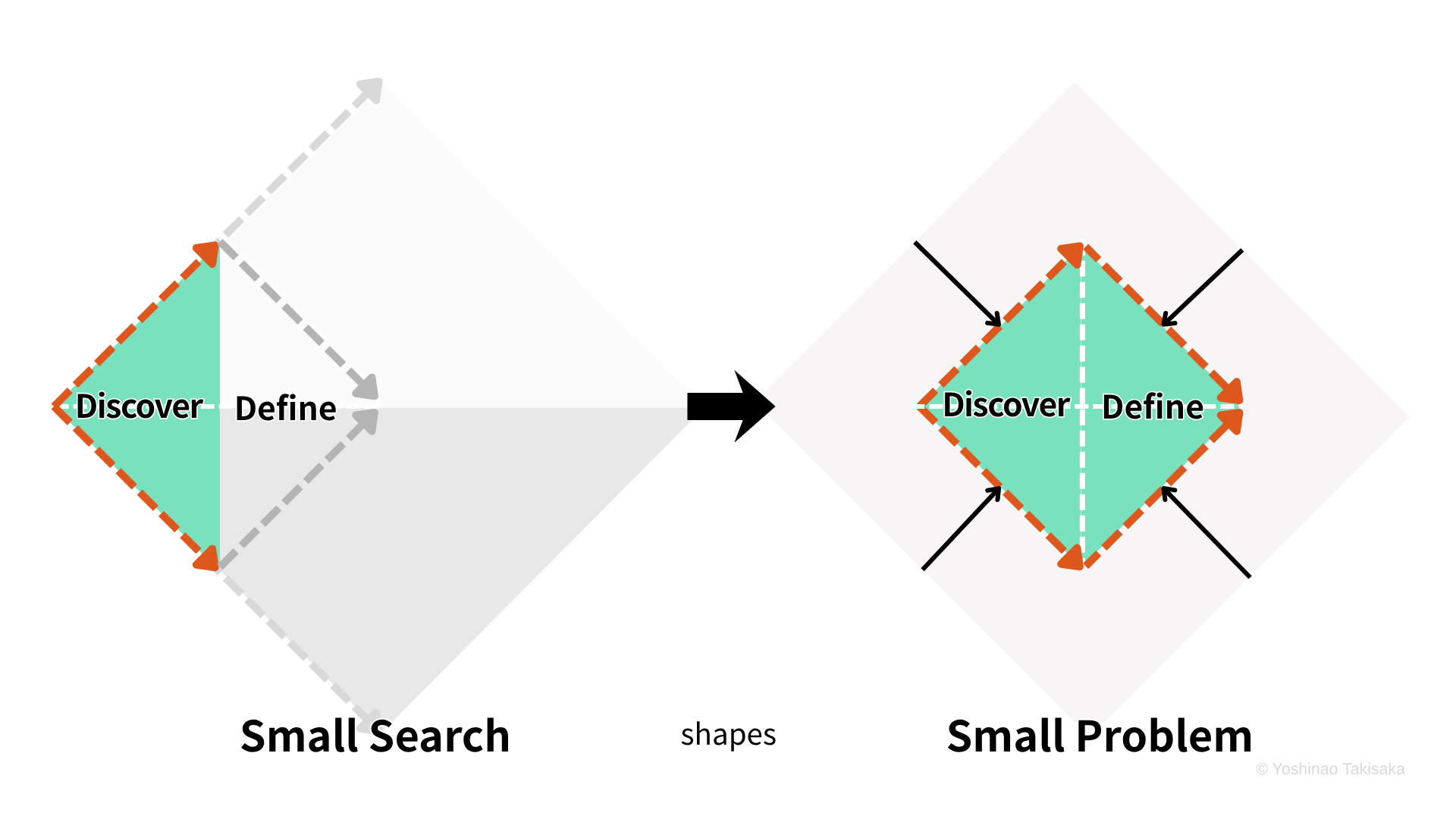 A shallow inquiry (Small Search) shrinks the reach of the problem definition itself (Small Problem). The difference in reach determines the size of the problem you can see.
The Double Diamond is now a shared language ―― running in workshops around the world, in new product planning, in the consensus-building of organisational change. And yet the ideation that actually unfolds in those rooms often stays bound to existing technologies and to objects that have already been put into words. Arguments that trace the surface. Dialogue that slides along the explicit.
Can making what lies beneath the water line visible on the map change the quality of the workshop itself, of the dialogue, of the thinking? That ―― not the diagram ―― is the real reason this essay draws a single auxiliary line.
The Water Line as Auxiliary Axis
 Adding a single horizontal axis, the water line, to the Double Diamond. The boundary between the explicit and the tacit appears in the diagram for the first time.
Imagine a horizontal axis piercing the centre of the two diamonds. This is the water line.
Above the water line lies the realm of the explicit, the visualised, and the shareable. Survey data, defined problem statements, and documented specifications belong here.
Below the water line lies the realm of the implicit, the embodied, and the unspoken. This is where you find the sense of unease felt in the field, the pre-verbal sense of direction shared by the team, and the tactile sensation of handling materials.
Here, I want to introduce the phrase the reach of inquiry. A team might say “we did Discover”, but a few days of desk research and several months of participant observation have entirely different downward angles and distances. How far did you dive beneath the surface? How deeply did you touch what is tacit? The angle of that reach distorts the shape of the diamond.
Crucially, Area = the total tacit knowledge touched. The angle extended towards tacit knowledge in each phase determines that phase’s area. The wider the area, the stronger the foundation of the design.
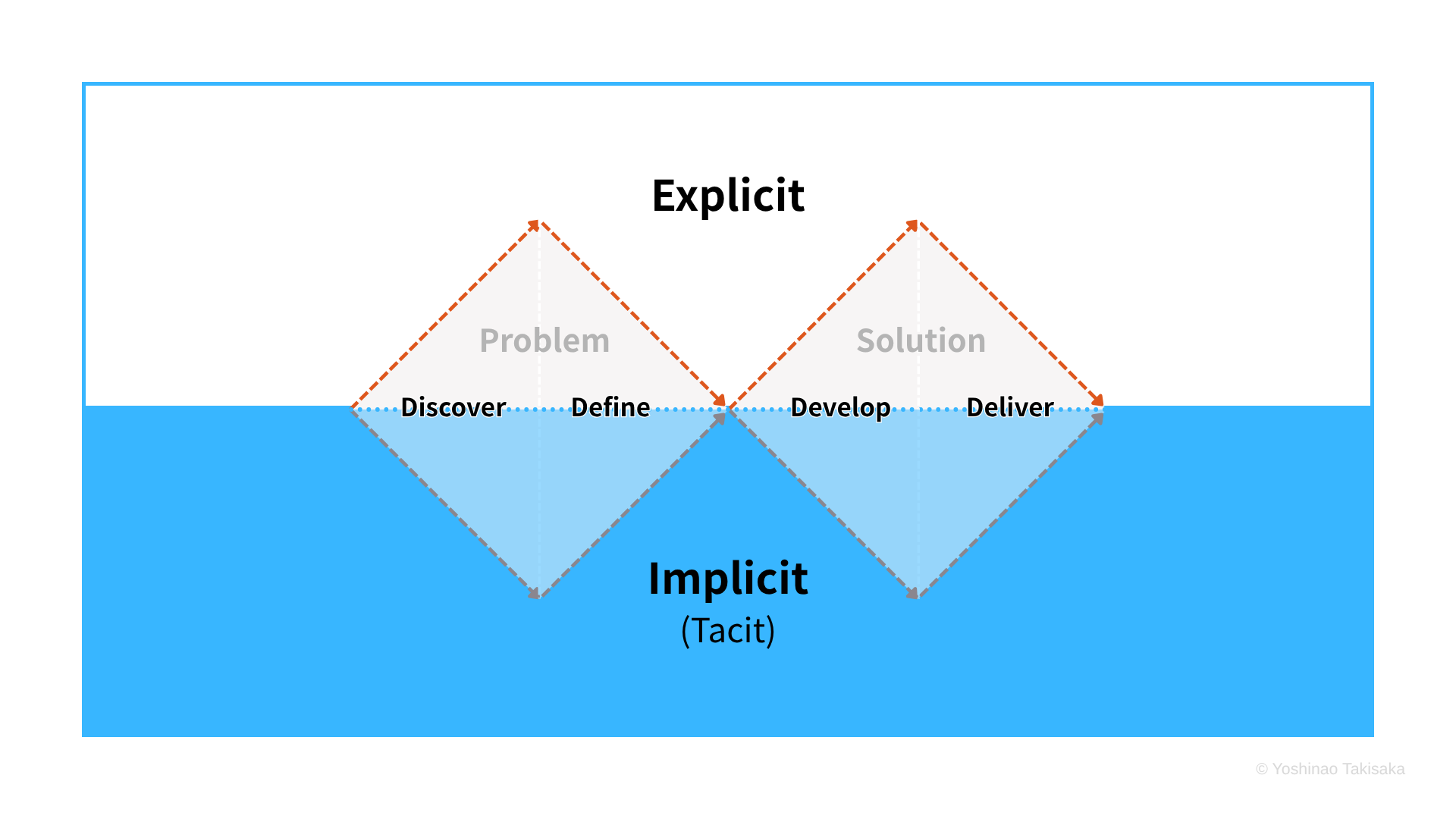 Double Iceberg: the four phases extend both above (Explicit) and below (Implicit / Tacit) the water line. The reach beneath the surface is precisely the area we want to look at in this essay.
The Line Wavers — Redrawing It as a Wave
Drawing the water line as a straight line gives the false impression that the boundary between explicit and tacit is static. In reality, the boundary wavers over time. We constantly move back and forth between the surface and the depths, repeating a cycle of sinking and surfacing.
Therefore, the water line should be drawn as a wave.
This water wave has three characteristics.
Wavelength represents the cycle of iteration. A short wavelength indicates high-speed agile iteration. A long wavelength indicates an inquiry involving a deep dive.
Amplitude represents the depth of the round trip between the explicit and the tacit. A line with a small amplitude merely skims the surface. A line with a large amplitude dives deeply time and again before returning to the shores of explicit knowledge.
Phase represents the synchronous relationship with the geometric position of the diamond. Do you dive deep at the centre of Discover, or at the entrance of Define? This timing changes the entire quality of the project.
This movement itself determines the quality of the design.
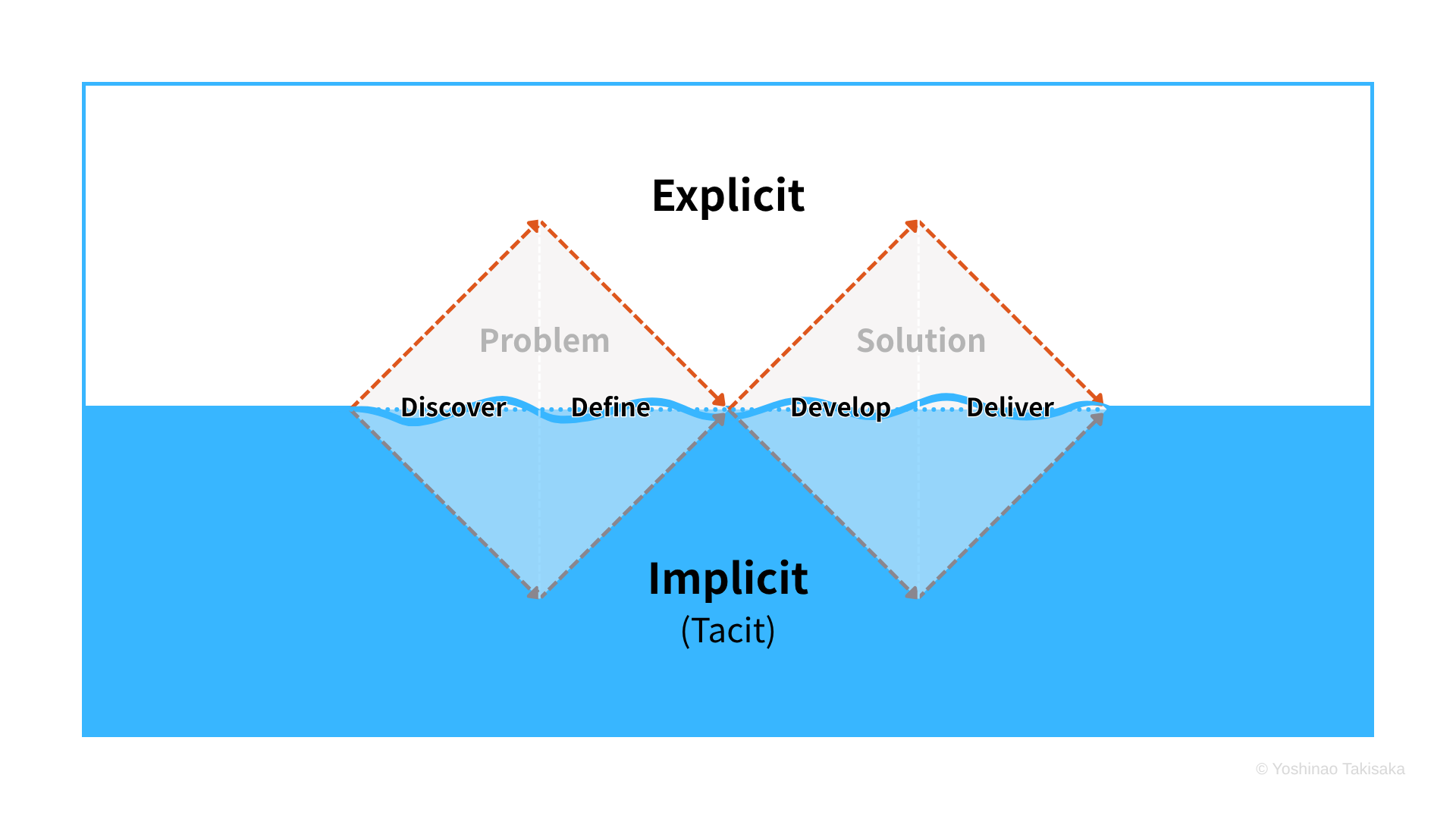 The water surface wavers as a wave: the boundary between the explicit and the tacit has a rhythm that rises and sinks over time.
Eight Fields — The 2×2×2 Structure
When you overlay the water line (wave) and the Double Diamond, each diamond splits top and bottom, revealing a total of eight triangles.
Diamond 1 or 2 (Problem Space or Solution Space). Left half or right half (Divergence or Convergence). Above or below the water line (Explicit or Tacit). The intersection of these three binary choices creates eight fields: 2 × 2 × 2 = 8.
Let me briefly sketch the eight fields, one by one.
① Discover-Explicit: Surface-level research, KPI design, reviewing existing data. Market size, competitor mapping, user demographic data. The information gathered here is documented and shareable.
② Discover-Tacit: Ethnography, embodied empathy, a sense of unease in the field, the embodiment of context. What the silence of an interviewee really means; what kind of operations the very smell of the factory floor supports. It is the tactile feel just before an observation becomes words.
③ Define-Explicit: Problem statements, requirements gathering, “How might we” questions. This is the centre of the field of explicit knowledge.
④ Define-Tacit: The pre-verbal intuition within the team that “this isn’t quite right”. The sense of direction behind the text of the problem statement, shared by everyone but not yet put into words.
⑤ Develop-Explicit: Prototypes, wireframes, specifications, code.
⑥ Develop-Tacit: The sensation of touching the material, the artisanal sense of craft, the embodied knowledge of design judgement. It is the immediate response from your own hands saying “this is wrong” when grasping a prototype. In a kitchen, it is akin to the chef’s instinct to rewrite a recipe the moment heat is applied to the pan.
⑦ Deliver-Explicit: Final deliverables, launch, documentation, operations manuals. The final form of the explicit.
⑧ Deliver-Tacit: The philosophy that lingers behind the explicit form before it reaches the body of the receiver. It is the time it takes for a product to sink into the tacit habits of the user.
These fields are not fixed compartments; adjacent fields inherit from one another. The embodied sense of the field gained in ② Discover-Tacit is externalised into a problem statement in ③ Define-Explicit. Similarly, the intuition lingering in ④ Define-Tacit passes directly into the prototype judgements of ⑥ Develop-Tacit.
And there is one line that matters most in this model:
The through-line from ② to ⑦.
Does the deepest discovery from the field, gained in Discover-Tacit, reach all the way to the final delivery in Deliver-Explicit? Whether or not this diagonal can be drawn decisively separates the quality of a design.
You might do excellent research, yet if that discovery fails to reside in the details of the final deliverable, the diagonal ②→⑦ is broken. This is the most frequent structure of failure.
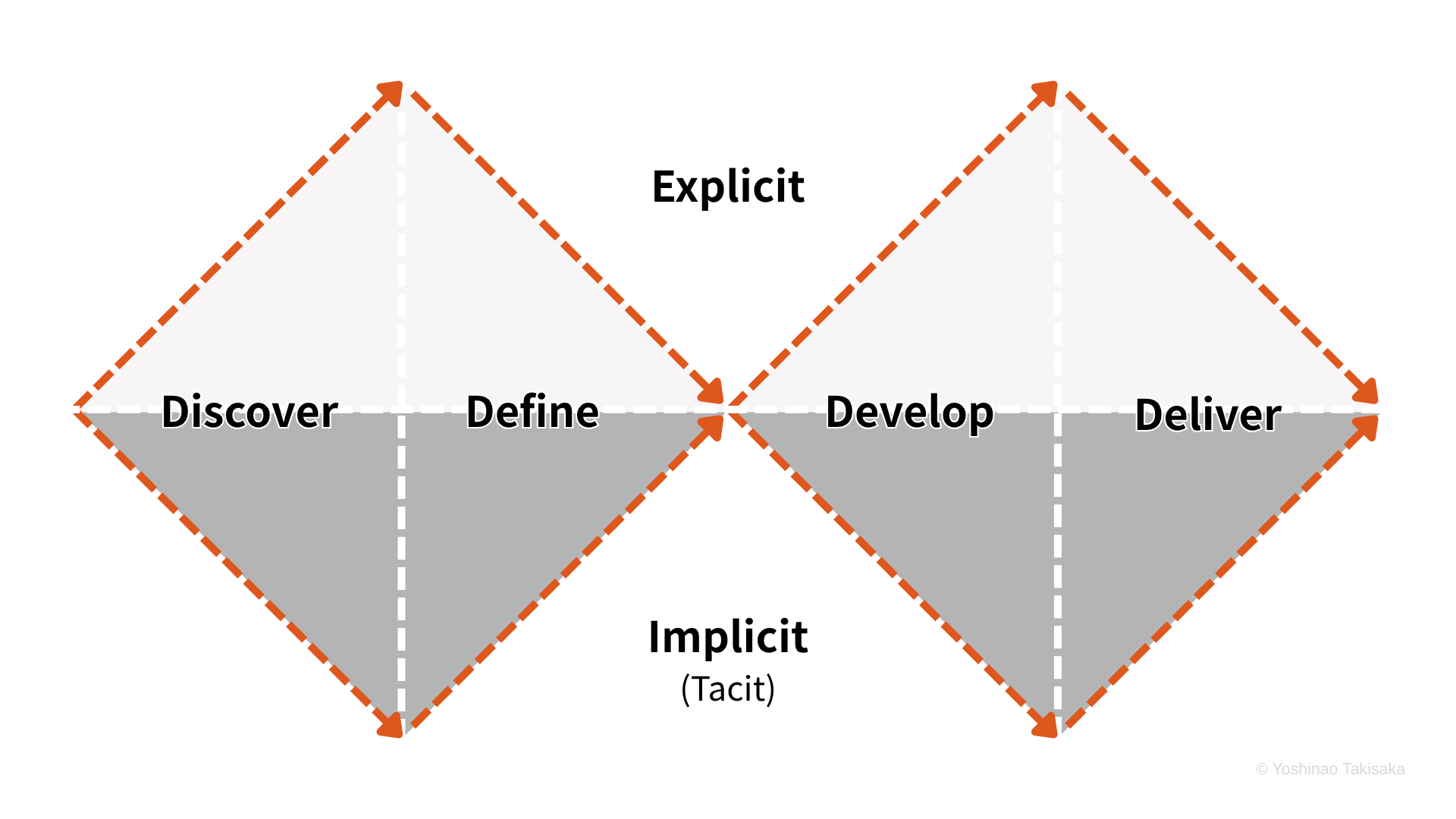 Double Iceberg: each phase can extend its reach in both the upward (Explicit) and downward (Implicit / Tacit) directions. The diagram shows its dynamic expansion with arrows.
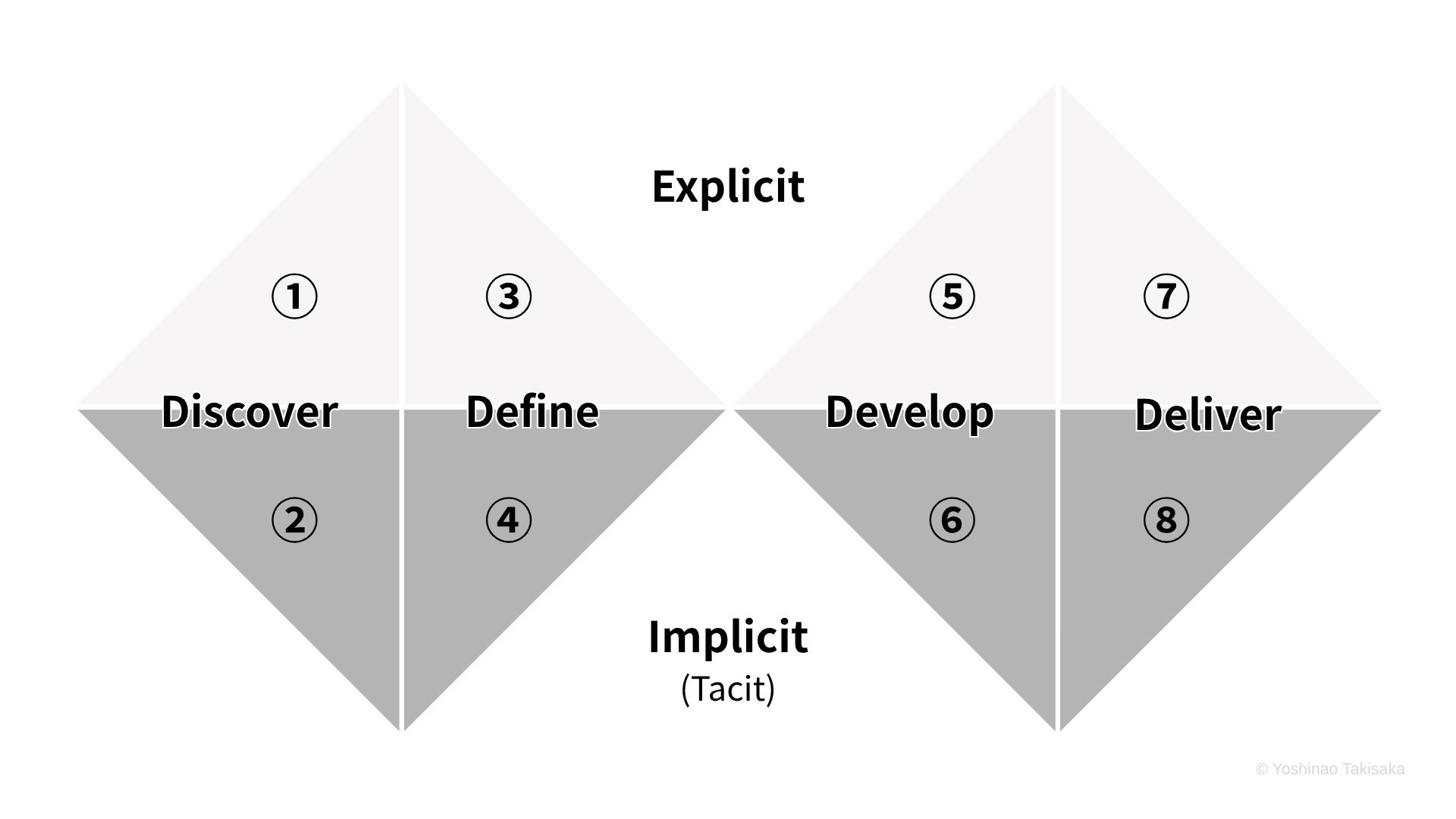 Eight Fields: the 2×2×2 = 8 fields created by the intersection of the time axis of Discover / Define / Develop / Deliver and the cognitive axis of Explicit / Implicit (Tacit). ①③⑤⑦ are the fields of explicit knowledge, ②④⑥⑧ are the fields of tacit knowledge.
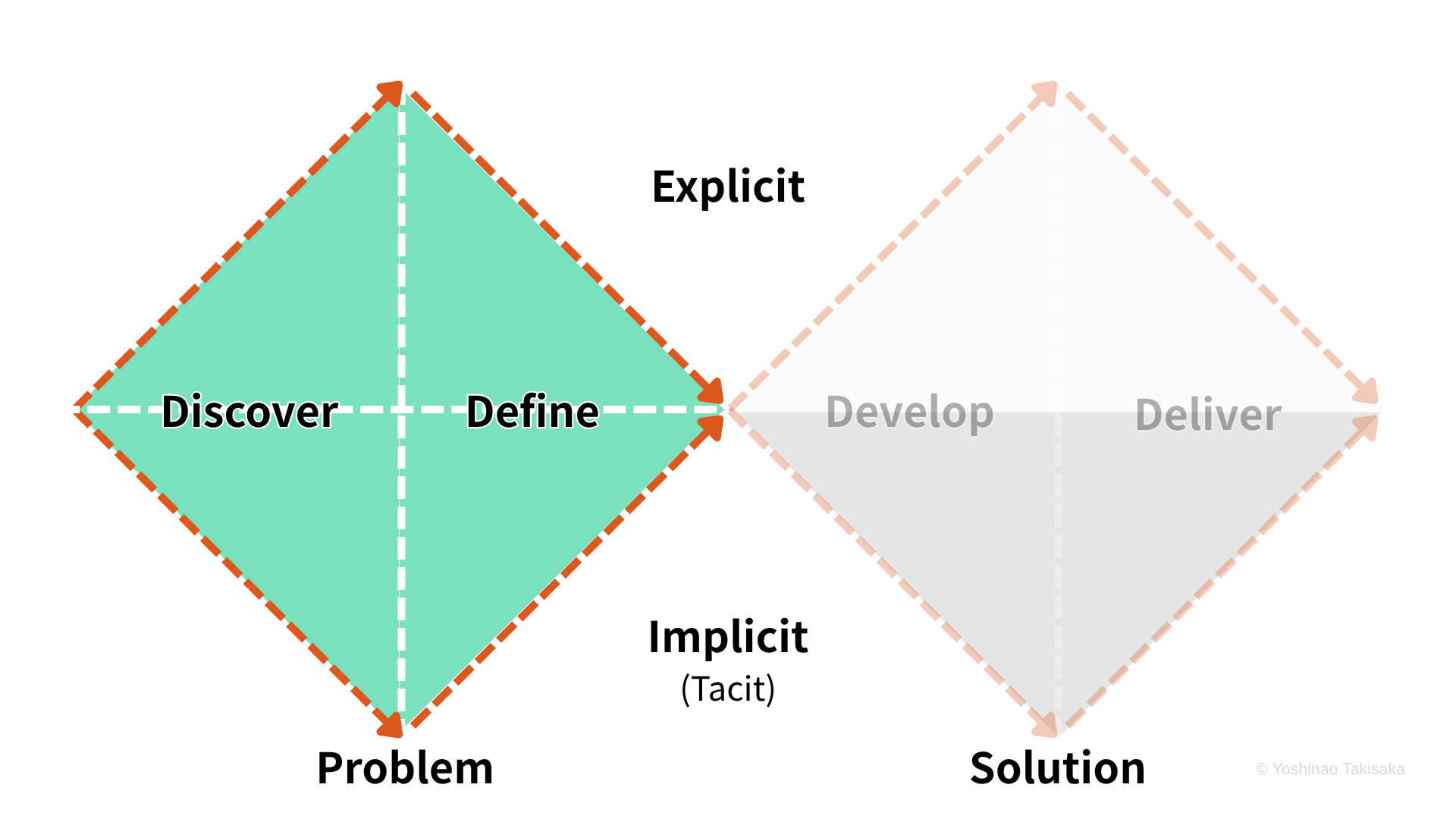 Focusing on a single phase: the Discover-Define diamond is itself a microcosm encompassing the four fields of the problem space (①②③④).
The Two Kinds of Knowledge Generate Each Other
The eight fields are not a still image. There is constant movement between them.
That movement is akin to an electromagnetic wave in physics.
When an electric field changes, that change generates a magnetic field. When a magnetic field changes, that change generates an electric field. The electric and magnetic fields are orthogonal, generating each other while propagating along a third axis. This is the structure of an electromagnetic wave.
Translated into this model, the field of explicit knowledge (the electric field) and the field of tacit knowledge (the magnetic field) are orthogonal. When explicit knowledge moves, tacit knowledge is awakened. Touching a prototype brings a new sense of unease welling up from beneath the surface. Conversely, when tacit knowledge moves, explicit knowledge is updated. The moment you try to put an embodied sensation into words, the requirements definition is rewritten.
The third axis is time. The round trip between the explicit and the tacit propagates the wave of the project forward. A project does not so much advance as it propagates.
“In the beginning was the Word, in the beginning was the Deed” — this passage from Goethe’s Faust ultimately dismantles the question of which comes first, the explicit or the tacit. The two generate each other. The moment you make something explicit, a new tacit understanding is born, which in turn demands the next explicit formulation.
The Irreducible
Here, I want to establish the philosophical grounding of this essay.
What exactly is this “tacit thing” beneath the surface?
Is it simply something “not yet put into words” that can eventually be made explicit given enough time and effort? Or is it something “fundamentally difficult to reach” that can never be made explicit, no matter how many words we exhaust?
How is this “tacit thing” beneath the surface to be read? The stance splits into two camps.
One side takes tacit knowledge as “that which has not yet been put into words”. With the right methods and time, it can eventually be converted into explicit knowledge. Nonaka’s theory of knowledge creation leans heavily in this direction.
The other side takes tacit knowledge as “that which is fundamentally difficult to reach”. It is the conviction that no matter how precisely a model is constructed, there is a residue that can never be made explicit. Polanyi’s “We know more than we can tell” aligns closely with this latter view ― and that is where my own stance lies.
Where does this model stand? Before getting to that answer, I want to talk about roses for a moment.
In my garden, the roses are in bloom.



 There is a beauty that photographs cannot capture.
Their hue, their scent, the way they stand, the way they sway in the wind — all of these possess a beauty that words cannot fully express. It doesn’t even show up on camera.
I have written about this before. Every time I try to capture it, the residue that escapes the writing quietly remains. The moment I call the colour “red”, the true depth of that red slips through the cracks of the word. The moment I call the scent “sweet”, its luscious freshness vanishes. If I try to name the swaying in the wind, the swaying itself stops.
This is what it means to be irreducible.
The sensation in your palm when striking a nail. The balance of a bicycle. The ability to recognise a friend’s face. The resistance of a knife blade entering the flesh of a fish. And the beauty of a rose. It is not that these refuse to be put into words. Rather, the moment they are written down, everything that was left unwritten is laid bare.
In design practice, we frequently confront this kind of knowledge. When we try to distil the tactile feel and intuition gained from a deep dive into a presentation deck, something inevitably spills over. The moment it is written down, the core escapes, just like the beauty of the rose.
Even so, the chef serves the dish. The designer draws the shape. The manager makes the decision. Without being able to fully explain “why it is good”, the body knows. In response to that embodied knowledge, a shape is born.
This model places this realm of the unspoken on the map as the fields beneath the surface (②④⑥⑧). It secures a location for what cannot be put into words, allowing it to refuse verbalisation.
This is the position I stand on.
I do not forcefully drag what resides in the tacit fields (②④⑥⑧) above the water line. I respect what would be lost if given form, and so I leave it formless.
The map is not the territory — yet, a map exists to help you land in the territory.
Drawing Your Own Project
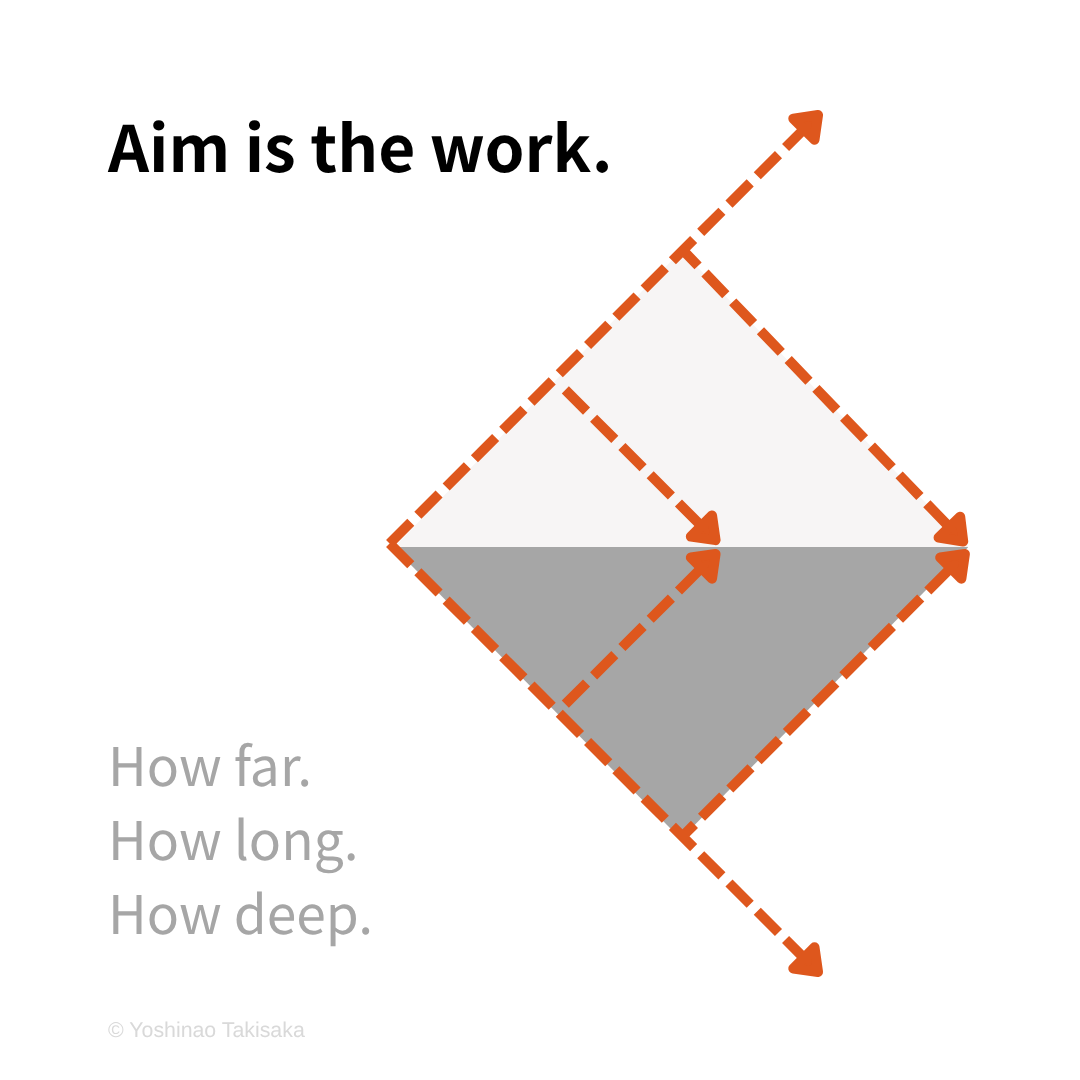 Aim is the work: what you aim at becomes the work itself. How far / How long / How deep — three axes for measuring your own reach.
By now, the vocabulary is mostly in place. Now it is time to use it as a tool.
First, however, I want to establish one thing: the shape of the diamond differs from project to project.
The length of the time axis, the depth of Up Reach and Down Reach, the heat poured into each phase. What kind of quality you pursued, and to what extent. The difference in this allocation determines the shape of the project. A perfectly symmetrical diagram almost never exists in reality.
 The shape of the diamond differs from project to project. There is no single “right shape”. The distortion is the personality of the project, and a clue for diagnosis.
Anyone with a pen and paper can diagnose a project using this model.
1. Determine the time axis — Place the start and end of the project along the horizontal axis. Is it a sprint of a few weeks, or a long campaign of several years? Fix the scale as a distance on the paper.
2. Boundaries of the 4 phases — Draw the boundary lines for Discover, Define, Develop, and Deliver. There is no need to divide them equally; reflect the actual weighting of time exactly as it occurred.
3. Draw the water line (wave) — Sketch the rough shape of the boundary between the explicit and the tacit. Sink the line deep during the periods you dived into the field, and lift it above the water line during the periods you were bogged down by documentation and presentations.
4. List the activities in each field — For each of the eight triangles, write down 3 to 5 activities you actually performed. Quantitative data in ①, field ethnography in ②, prototypes in ⑤, the artisanal sense of craft gained while touching materials in ⑥.
5. Adjust angles and areas — Deform the triangles according to the weighting of the listed activities. A one-week questionnaire survey and a six-month live-in observation have completely different downward angles. Area = the total tacit knowledge touched. Draw this as a distortion.
6. Observe the distortion — Identify fields that are too large, too small, or blank. It is common to have a splendid problem statement (③) while the shared embodied sense of the problem (④) remains blank. This distortion visualises the pathology.
7. Draw the through-line from ② to ⑦ — Check whether the deepest discovery reached the final delivery. If the line is broken, note where it snapped.
When drawn this way, structural flaws appear as geometric distortions. The typical patterns I’ve observed can be broadly categorised into six types.
(1) The Consultant Type — Only the explicit fields (①③⑤⑦) are large, and the tacit fields are blank. The data and presentations are well-organised, but the project lacks the atmosphere of the field and embodied empathy. It is a project assembled entirely in the head. The prescription is to forcefully secure time spent in ② and ④.
(2) The Artisan Type — The tacit fields (②④⑥⑧) are bloated, and the explicit fields are emaciated. Good things are being made, but you cannot explain to others why they are good, so the work doesn’t scale. It is necessary to incorporate verbalisation into ③ and ⑦.
(3) The Rushed Type — The amplitude of the wave is small, and the reach beneath the surface is shallow overall. The pressure for short-term results has robbed the team of time to dive deep. You are jumping to solutions based only on surface-level information.
(4) The Explorer Type — The amplitude is large, but the diagonal ②→⑦ cannot be drawn. Despite deep discoveries, they do not reach the final deliverables and vanish halfway. There is an absence of someone to translate the understanding of the problem into the design of the solution.
(5) The Define-Heavy Type — Only ③ and ④ swell, while ⑤ and ⑥ are emaciated. Too much heat is poured into problem definition, leaving no time for the exploration of solutions. You must set a timebox on the first diamond and forcefully move to the phase of working with your hands.
(6) The Deliver-Heavy Type — Only ⑦ and ⑧ are large, and the inquiry in ① through ④ is shallow. You have entered a “just build it for now” mode without questioning the problem. You must force an investment in the first diamond.
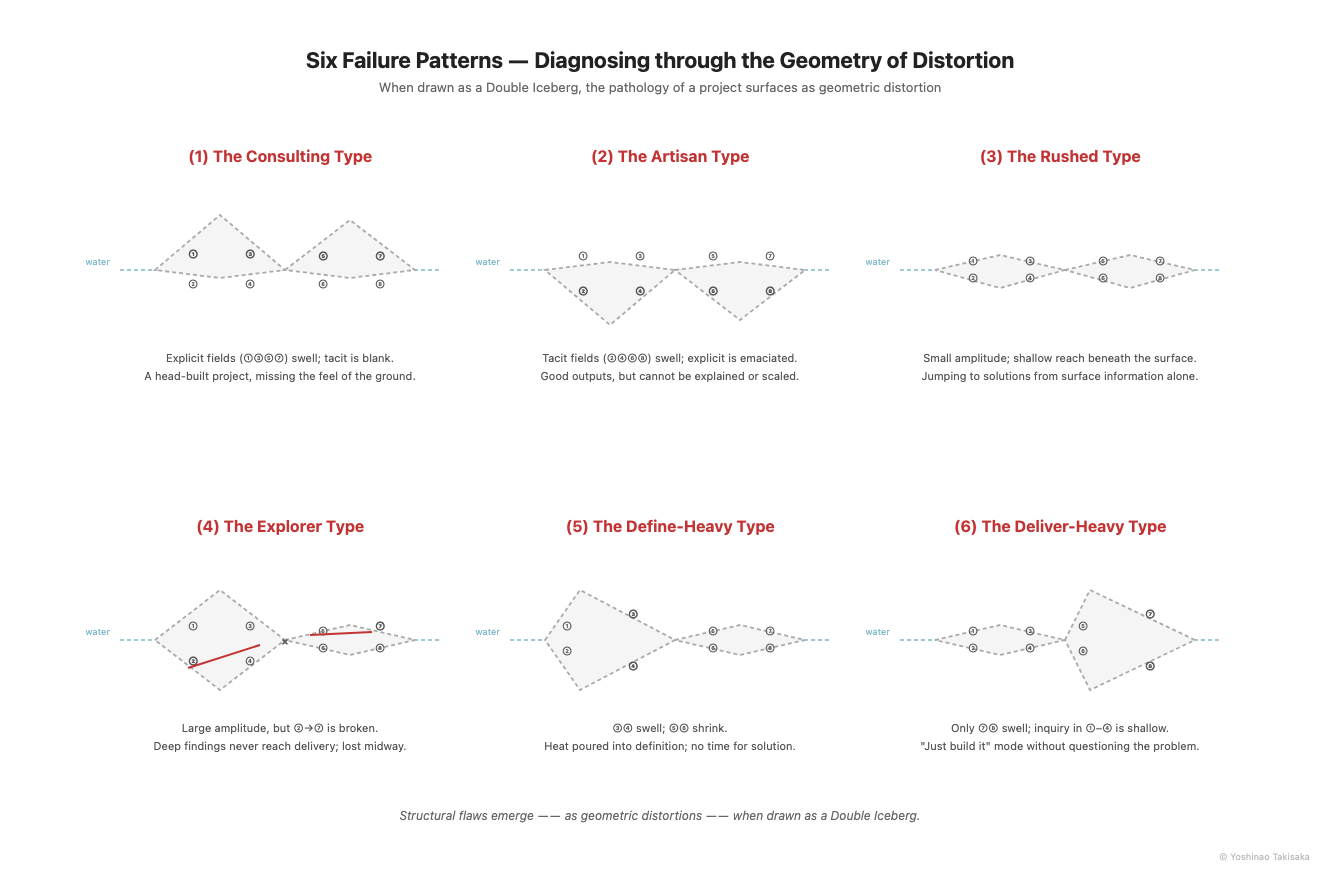 Six Failure Patterns ―― from the Consulting Type to the Deliver-Heavy Type, each appears on the double iceberg as a geometric distortion. Where among ① to ⑧ does it swell, and where is it emaciated? And can the diagonal ②→⑦ be drawn? The shape speaks the pathology.
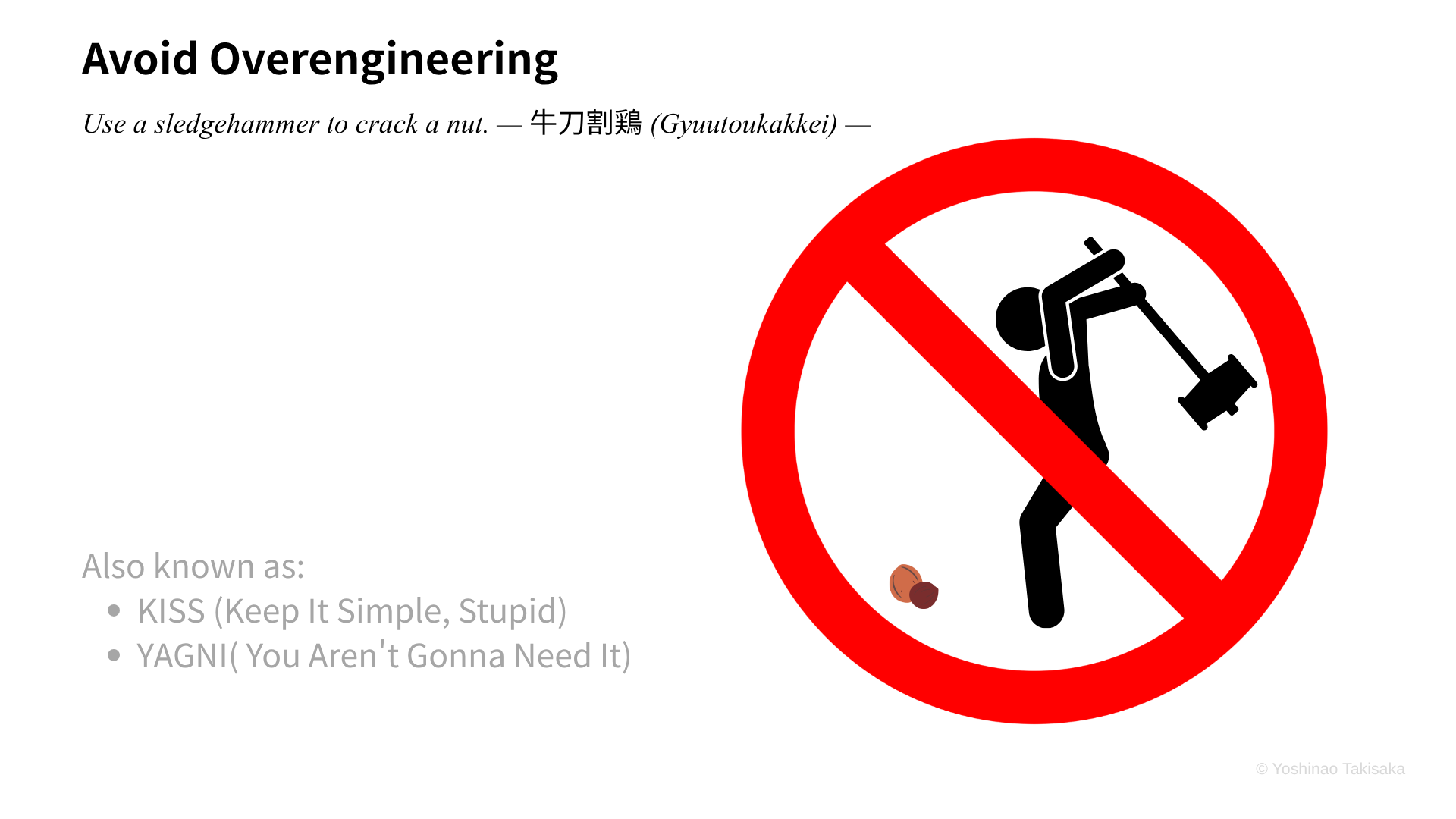 Another caution: extending the reach too far is also a form of failure. “Using a sledgehammer to crack a nut.” — Both KISS / YAGNI and the classics say the same thing. Stop the reach of inquiry at a depth appropriate for the project.
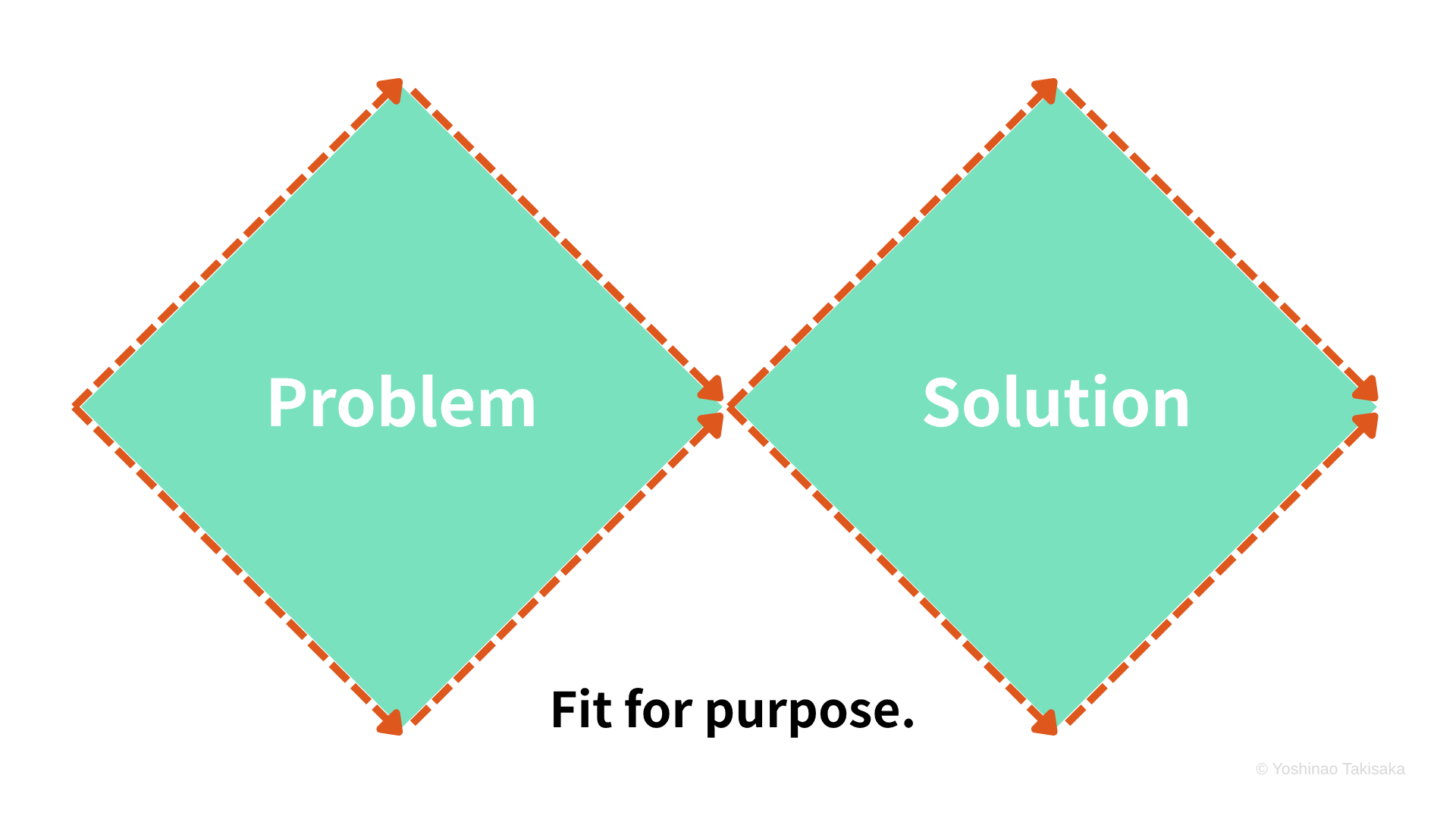 Fit for purpose: “the right shape” does not mean tidy and symmetrical. It is about whether you were able to draw with your own hands the distortion that fits the purpose of the project.
When using this as a tool, the most important thing is not to try to draw it beautifully. The distortions and blanks are exactly what speak to the real issues the project was harbouring. Just as a chef looks at a plate and says “this is missing”, you can look at the diagram and say “this is empty”. That is enough.
The small physical movement of drawing a line on paper pulls out the memory of the project. A hand-drawn, distorted double iceberg tells you far more than a tidy slide.
The Strength of This Model
The strength of this model is that you can use it without changing your existing process. Whatever service-design work you are running through the Double Diamond, whatever ideation workshop you are facilitating ― the procedure itself doesn’t need to change. Simply swap the framework and the metaphor for this one, and participants begin to direct their attention to their own tacit knowledge and embodied knowledge.
Until now, turning sensation and embodied knowledge into words has required deep introspection, dialogue, and the presence of a skilled facilitator. But with this one diagram on the table, participants can turn their own gaze ― toward their purposes, their embodied knowledge, and the sensations that don’t yet have names.
Whether you are planning a new venture, designing a service, or starting any work that lies ahead of you, I hope you will try using this model.
As a Thought Experiment
This Double Iceberg Model is not a finalised theory. It is strictly a thought experiment. The naming is provisional and may change if a more appropriate metaphor is found. I publish this not as a closed system, but as an open working note.
Just by drawing a single line, a familiar landscape looked entirely different. I have written this far in an attempt to translate that small surprise into a shareable vocabulary.
Will this line truly change the scenery? Verifying that will happen in the practice that follows.
Thank you for reading this far.
In a project you were recently involved in, where in the diagram was the understanding you couldn’t quite put into words located? Or do you have memories of a project where “the right shape” was not symmetrical?
If anything in this essay resonated with you, I would be delighted if you hit the like button. Sharing it with someone else would be even more encouraging.
Until the next post.
The Thinking Behind the Scenes
I want to leave here, as an entryway, the concepts and philosophies that could not be deeply developed in the main text, but which serve as the subterranean veins of this argument.
Reference points mentioned in the text:
- Michael Polanyi, “The Tacit Dimension” (1966) — The classic that established the concept of tacit knowledge with the thesis We know more than we can tell. The dual structure of focal and subsidiary awareness is the philosophical foundation of the water line in this model.
- Ikujiro Nonaka & Hirotaka Takeuchi, “The SECI Model” (1995) — The spiral of Socialisation, Externalisation, Combination, and Internalisation. The original 2×2 structure that this model attempts to unfold along the time axis.
- Béla H. Bánáthy, “Divergence-Convergence Model” (1996) — The geometric origin of the Double Diamond.
- Design Council, “The Double Diamond” (2005) — The very map upon which this essay drew an auxiliary axis. https://www.designcouncil.org.uk/resources/the-double-diamond/
- Kurt Lewin, “Field Theory” (1951) — The lineage of social science that grasps a field as a space drawn with lines of force. The distant background of the eight fields.
- Martin Heidegger, “Sein und Zeit” (1927) — The three layers of presence-at-hand, readiness-to-hand, and being-in-the-world. The foundation for the ontological reading of the water line.
- Iain McGilchrist, “The Master and His Emissary” (2009) — The asymmetry of the left and right hemispheres. The neuroscientific counterpart to above/below the water line.
- Alfred Korzybski, “The map is not the territory” (1933) — The distinction between the map and the territory. The ground of this essay.
Concepts not deeply explored in the text, but which support the argument:
- Donald Schön, “reflection-in-action” (1983) — Reflection within action. One of the philosophical foundations of the wavering line.
- Maurice Merleau-Ponty, “Phenomenology of Perception” — The intertwining of the body and the world, prior to thought.
- James Clerk Maxwell, “Metaphor of the Electromagnetic Field” (1861-1865) — The physical structure where electric and magnetic fields are orthogonal and generate each other.
- Suoheimo et al., “Iceberg Model of Design Problems” (2020) / Berret & Munzner, “Iceberg Sensemaking” (2022) — Proximate research intersecting design and the iceberg.
- Goethe, “Faust” — “In the beginning was the Word, in the beginning was the Deed”. The mutual generation of word and deed.
Note: This manuscript was published after deepening my (Yoshinao Takisaka’s) actual experiences and thoughts through dialogue with AI, and structuring and writing it in collaboration with AI. Powered by Gemini and Claude.
Note: This essay is a thought experiment, presented as a model in the process of being refined while receiving responses from readers.
Note: Some of the diagrams in this text were generated in collaboration with AI after the article was written.
#Design #DesignProcess #DoubleDiamond #TacitKnowledge #SECI #ThoughtExperiment #KnowledgeManagement #AI #LLM